


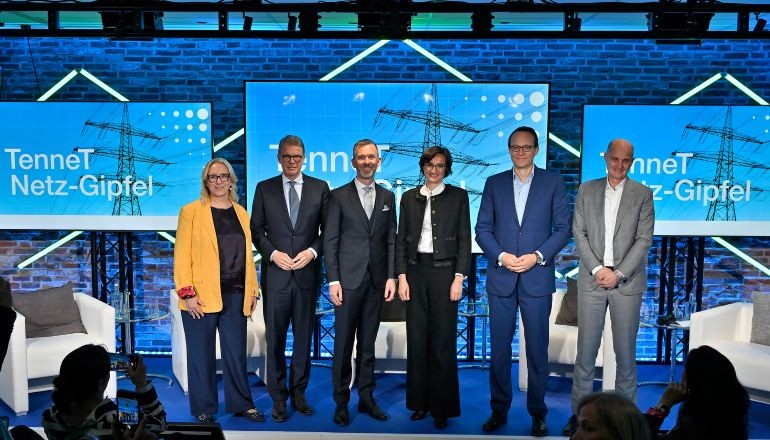
Energy, industry and finance executives called for better investment conditions and faster implementation of Europe’s energy transition at TenneT Germany’s Netz-Gipfel 2026 in Brunsbüttel.
TenneT Germany said discussions at the two-day event focused on Europe’s energy sovereignty, financing future infrastructure and building an affordable, secure and competitive energy system.
The participants argued that energy sovereignty depends on electrification, expansion of domestic renewables, stronger power grids, flexible storage capacity, back-up power plants and deeper European integration.
TenneT gave journalists tours of the SuedLink Elbe tunnel construction site and an offshore converter during the first day of the event.
The second day featured discussions between Tim Meyerjürgens, chief executive of TenneT Germany, Dr Markus Krebber, chief executive of RWE, Christian Sewing, chief executive of Deutsche Bank, Birgit Potrafki, board member and chief financial officer of Salzgitter AG, Tim Holt, board member of Siemens Energy, and Aurélie Alemany, chief executive of enercity.
“Energy sovereignty now determines security, competitiveness and prosperity,” said Tim Meyerjürgens, chief executive of TenneT Germany.
“For this, internationally competitive and reliable investment conditions are needed immediately so that the necessary capital can flow into grid expansion without delay.”
“The transformation of the energy system involves infrastructure with very long lifetimes,” said Dr Markus Krebber, chief executive of RWE.
“In order to invest here, attractive framework conditions, a reliable investment environment and faster permitting procedures are required.”
“We are facing a financing marathon: grids, energy supply and industrial transformation require investment on a major scale,” said Christian Sewing, chief executive of Deutsche Bank.
“For capital to reach the economy, we must reduce complexity and significantly accelerate implementation.”