


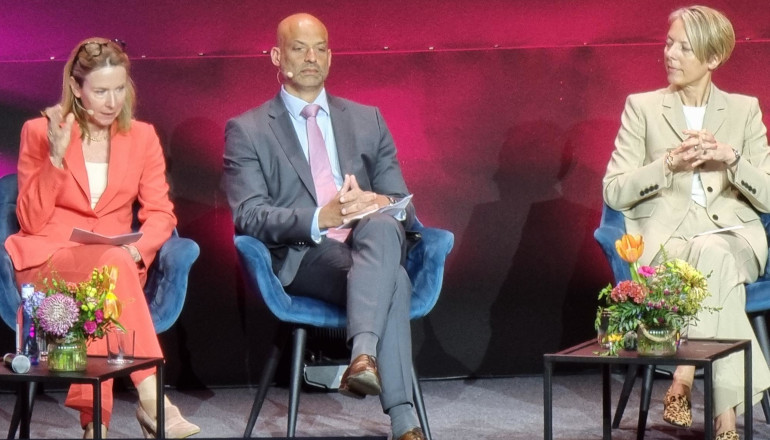
Developers and governmental departments must find a way to break down “longstanding” co-operation barriers to deal more effectively with a rising threat of cyber and physical attacks on energy infrastructure, WindEurope 2026 has heard.
NATO Deputy Assistant Secretary General for Innovation, Hybrid and Cyber James Appathurai (pictured middle) said security challenges “are increasing”, but that joined-up responses by “industry, defence, police and internal ministries” is a “real problem”
He pointed to seabed mapping activities that are believed to have been conducted by Russia “for decades” and allegations directed at China for the “deliberate implementation of malware” as areas of particular concern.
“It is not stopping… I think everyone has experienced drones around their infrastructure,” he added.
“Undersea infrastructure is very much targeted, and we have deployed all sorts of assets.”
Appathurai told delegates that plans for a “mesh network” outlined in last year’s Hamburg Declaration to link North Sea wind farms could play a key role in countering the threat and they would result in “not just one cable to shore as it is more vulnerable”.
He also advocated additional measures including increased investment in cyber security, improved repair capabilities and integration of sensors in physical assets.
Equinor SVP Global Offshore Wind Trine Borum Bojsen agreed that threats to energy infrastructure had “intensified in recent years, unfortunately”.
However, she said that any response would “need clear roles and responsibilities” including the detection of threats by industry plus the defence of assets which “we will leave happily to states” to provide.