


The European Commission says it will develop proposals within “days” to modify the EU’s emissions trading system as part of wider plans to limit the impact of increasing energy prices on the industrial sector.
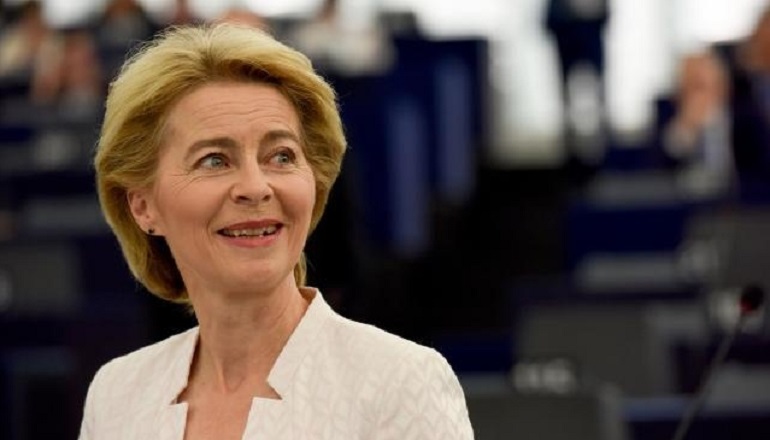
Commission President Ursula von der Leyen said yesterday that the EU Executive is preparing four measures to “modernise” the ETS – the bloc’s primary driver of clean investment – and make it “more flexible” in light of global energy price spikes resulting from the conflict in the Middle East.
Speaking at a press conference following the European Council meeting in Brussels, von der Leyen said that the Commission will update the benchmarks for free allocation of emission allowances – the permits industrial sites are required to have in order to emit carbon dioxide. It will also “increase the firepower” of the market stability reserve, which governs the supply of ETS permits, to reduce price volatility.
She added that the Commission is also working on medium-term measures for the ETS as part of a planned review of the framework that is due to be published in July. These include “a more realistic trajectory for free allowances” for industries beyond 2035 “and a more level playing field for our maritime sector”, von der Leyen said.
Finally the Commission will also present plans for a €30bn “ETS Investment Booster” mechanism, funded by 400m ETS allowances, to finance decarbonisation projects in the industrial sector.
The fund will operate on a first come, first served basis with a focus on lower-income EU countries.
“The emissions trading system is working,” said von der Leyen. “It has massively reduced gas consumption. Because of that, it has reduced our dependency on imports of fossil fuels, and it has reduced our vulnerability. And it has driven major investments in the energy transition in the low-carbon energy sources like renewables and nuclear that are homegrown and give us independence. But we need to modernise it and make it more flexible.”
Vonder Leyen said that in addition to tweaks to the ETS, the Commission is also drawing up measures to address other components of energy pricing, including grid charges, taxes and levies, and the cost of energy itself.
The move follows recent intense lobbying efforts from Europe’s industrial sector over energy prices and competitiveness.
In yesterday’s Council meeting, EU leaders called on the Commission “to present without delay a toolbox of targeted temporary measures to address the recent spikes in the prices of imported fossil fuels arising from the crisis in the Middle East”.
Von der Leyen said that the measures would be “temporary, tailored and targeted”.
“We have immediate relief where it’s possible, we have structural changes where necessary,” she said.