


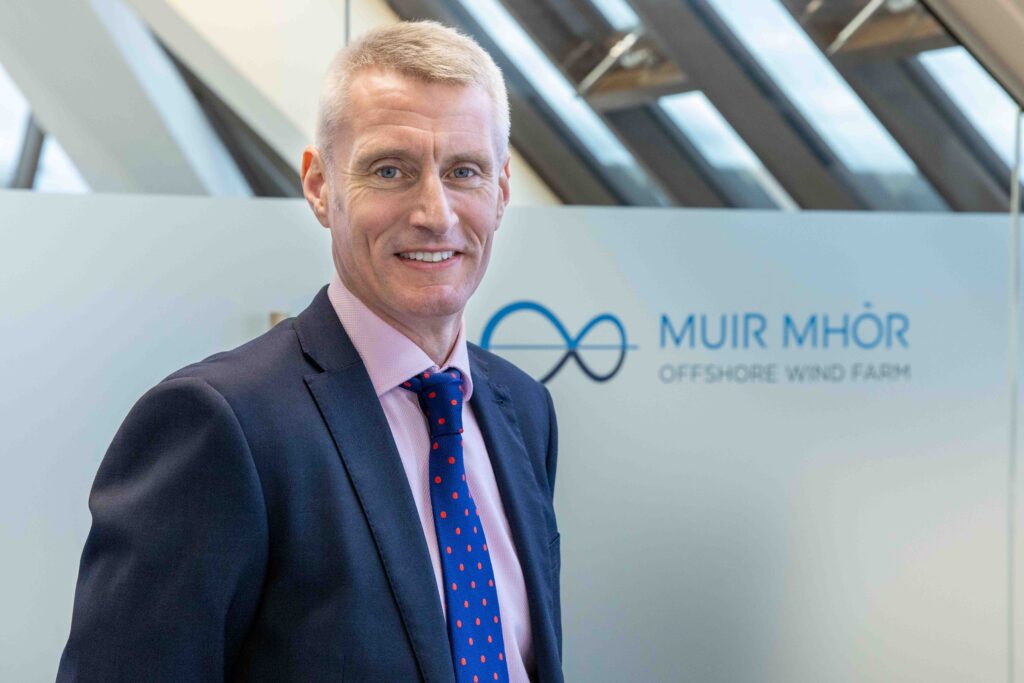
In this Q&A, Muir Mhòr project director David Hinshelwood discusses government support for floating projects and the UK’s “generational opportunity” to become a global leader in the nascent technology.
Q: What is your message to people attending Scottish Renewables’ Offshore Wind Conference 2026 in Glasgow this week?
A: It’s such an exciting time to be part of the UK’s offshore wind revolution. You can feel the momentum building as we head towards a new era of clean electricity, and Muir Mhòr is right at the centre of it all.
This conference falls at the perfect time, shortly after the announcement about Allocation Round 7 (AR7) and with a pipeline of pioneering projects on the horizon. All in all, 2026 is shaping up to be a really important year for our sector.
Q: What, in your view, do this month’s AR7 results mean for the floating wind sector?
A: For floating wind projects like Muir Mhòr, it is great to see the UK Government continuing to focus on cutting edge technologies as it seeks to deliver its mission to achieve clean power by 2030.
There is now a huge opportunity for our industry to work together, commercialise, and deploy floating offshore wind at scale so we can put Scotland and the UK at the centre of a new global industry.
We are blessed with an incredible natural resource. The AR7 figures speak for themselves, with the projects in this round alone capable of producing enough clean electricity to power the equivalent of more than 12 million homes.
Q: What are the main challenges for developers and how is Muir Mhòr navigating turbulence in the sector?
A: We are developing one of the world’s first commercial scale floating offshore wind projects, and being at the forefront of a new industry inevitably brings its fair share of challenges.
However, we have built an excellent team and are confident we can overcome any obstacles. Having already achieved planning consent for our onshore infrastructure, we are awaiting the outcome of our offshore application, and our aim is to connect to the grid in the early 2030s.
Q: Does the government and the sector have the fundamentals in place to accelerate progress in making the UK a global leader in floating wind?
A: There’s no doubt that the UK is superbly placed to be an international leader in the development of offshore wind, as well as a global leader in floating offshore wind.
This was illustrated by the fact that AR7 was Europe’s biggest ever offshore wind auction, and we are confident that both the UK and Scottish governments are committed to delivering on this generational opportunity.
As we know, more offshore wind will be needed to meet the increasing demand for electricity in the years ahead, so getting it right is vital, and the resulting prize will be significant.
Q: Can you give us a quick update on the Muir Mhòr project and what milestones you are expecting to hit?
A: Once operational, our wind farm will be able to generate up to 1GW of clean and renewable power every year, providing enough green energy for the equivalent of up to 1.2 million homes.
We are currently focused on achieving our offshore consent and have been working closely with the Scottish Government, which has previously committed to taking no longer than 12 months for a section 36 application.
We are also making progress on grid, working with the UK Government and the independent National Energy System Operator (NESO) to accelerate this process.
In terms of our supply chain, more than 250 businesses have already registered on our supplier portal, and we are entering into discussions with tier one contractors.