


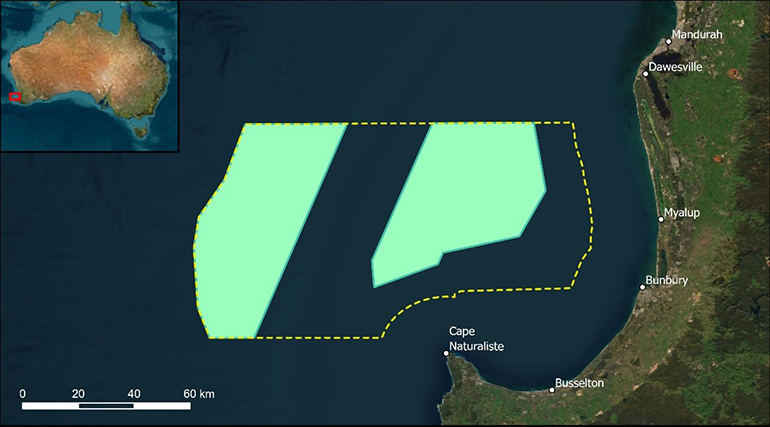
Australia has offered final feasibility licences to three offshore wind projects that could deliver around 4GW into Western Australia’s South West Interconnected System.
Bunbury Offshore Wind has been offered two licences in the Bunbury zone and Westward Wind has been offered one, said ministers Chris Bowen and Josh Wilson.
Acceptance of the offers will allow detailed investigations and consultation under the feasibility licence framework, added the ministers.
Bowen said: “These licences are another important step towards up to 4 GW of cleaner energy for Western Australian communities and industries.”
“As well as providing reliable, renewable electricity throughout the day, offshore wind can keep generating into the evening, harnessing the consistent, high-speed winds of the Australian coastline,” said Bowen.
“Generating cleaner and more reliable electricity in the evening reduces the amount of gas that Australia needs to keep the lights on,” added Bowen.
Wilson said the government wants to maximise the state’s renewable resources to provide cheaper, cleaner energy for households and industry.
“Offshore wind provides reliable, large-scale generation at times of the day or night that complement onshore renewables, delivering a more consistent, cleaner energy supply for WA,” said Wilson.
“In November, renewables provided a record 56 percent of generation to Western Australia’s main electricity grid,” added Wilson.
Bowen has also opened applications for research and demonstration licences to allow offshore renewable technology trials in Australian waters.
“Applications for R&D licences are now open for all of Australia’s six offshore wind zones,” said Bowen.
“These licences will give certainty to domestic and international developers, universities and research cooperatives to pioneer new technological advances in Australian waters,” added Bowen.
No feasibility licences will be issued in the Illawarra after BlueFloat withdrew its application, and a preliminary decision has been made not to offer licences in the Bass Strait due to a lack of competitive bids.
Both zones remain available for research and testing through R&D licences, the ministers said.