


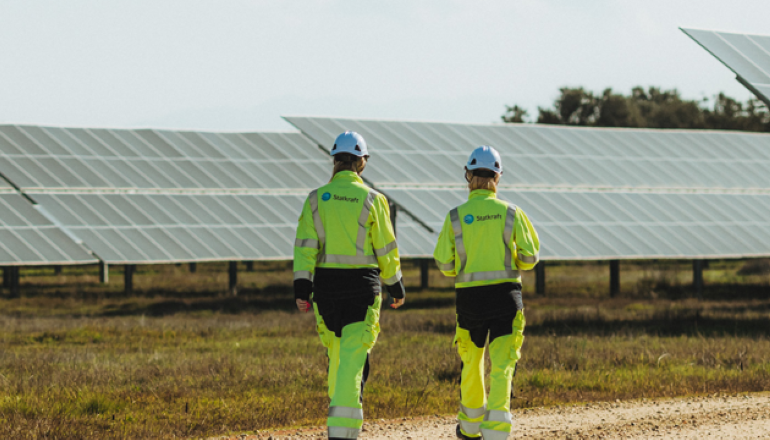
Statkraft has inaugurated a series of major solar and battery projects in Brazil during the COP30 climate summit in Belém, marking a key milestone in the country’s clean energy expansion and the company’s global decarbonisation strategy.
Norway’s Minister of Climate and Environment Andreas Bjelland Eriksen, Bahia Governor Jerônimo Rodrigues and Statkraft chief executive Birgitte Ringstad Vartdal attended the ceremony, which celebrated the launch of the 76MWp Morro do Cruzeiro Solar and 198MWp Santa Eugênia Solar projects in Bahia.
Statkraft is also commissioning the 69MWp Serrita Solar project in Pernambuco later this year. Together, the three facilities represent an investment of NOK2.3bn (€190m) and will add 340MWp of clean energy to Brazil’s power system – equivalent to around 5% of all new solar capacity expected nationwide in 2025.
The sites will collectively generate 789GWh of electricity annually, exceeding Norway’s entire solar production, and will cut about 111,000 tonnes of CO₂ each year. Including Statkraft’s associated wind assets, total output from the hybrid portfolio reaches 3400GWh per year.
“These projects directly support the global goals to triple renewable energy capacity, ensure a just transition from fossil fuels, and foster local development in a sustainable way,” said Vartdal. “This is green transition in practice, and a clear signal that Statkraft is delivering results that matter for Brazil and the global climate effort.”
Fernando de Lapuerta, executive vice president of Statkraft’s international business, said: “By investing in innovative renewable solutions and working closely with local communities, we are not only supporting Brazil’s energy transition but also contributing to global climate goals. The projects help phase out fossil energy sources and strengthen a more robust, diversified, and emission-free energy mix in Brazil – a country already among the world’s leaders in renewables.”
Statkraft said the new plants reflect findings from its Green Transition Scenarios report, which shows that while the world could still meet the Paris Agreement’s 2°C goal, achieving 1.5°C would require a much faster pace of emissions cuts.
“COP30 in Belém marks a pivotal moment for global climate action,” said de Lapuerta. “Our scenarios show that it is still possible to reach the 2-degree target of the Paris Agreement, but this requires a significantly faster pace of emission cuts than we see today. Solar energy, in combination with batteries and wind power, is the fastest and cheapest way to cut emissions and ensure a just transition.”
With these additions, Statkraft’s total capacity in Brazil rises to 2.3GW, positioning it among the country’s largest renewable energy producers. The hybrid projects combine solar, wind and storage technologies to ensure stable, reliable power generation and strengthen grid resilience.
Statkraft Brazil country manager Thiago Tomazzoli said: “We are committed to generating positive social impact by creating employment opportunities, enhancing local infrastructure, and establishing vocational training programmes. As part of our efforts to reduce environmental impacts, we collaborate with communities on initiatives such as tree planting and beekeeping.”