


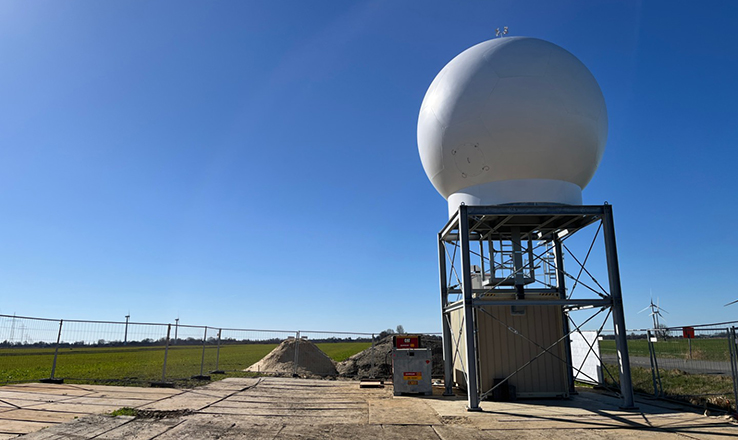
The Fraunhofer Institute for Wind Energy Systems IWES has put an innovative wind radar system into operation in Germany.
Fraunhofer IWES said the so-called Dual Doppler Wind Radar (pictured) enables ultra-fast three-dimensional wind field measurements.
The system, consisting of two synchronously operating radar units, was set up near the DLR research wind farm WiValdi in the district of Stade in Lower Saxony and has been delivering measurement data for the first time since the beginning of June. Once the measurements in Germany have been completed, an offshore measurement campaign is planned in England.
The radar system was developed and built by the company SmartWind Technologies from Texas, USA. As part of the Wind Farm RADAR project, which is funded by the German Federal Ministry for Economic Affairs and Energy, the radar system is being scientifically validated for the first time by Fraunhofer IWES in collaboration with ForWind – Carl von Ossietzky University of Oldenburg.
Fraunhofer IWES is seeking to establish dual Doppler wind radar technology as a new measurement technique in view of the increasing demands on electricity generation from renewable sources.
The institute said it could provide crucial data for site assessment and optimisation of wind farms. The radar system could be used both during the planning phase and parallel to the operation of existing wind farms.
The system measures wind conditions over an area of more than 1000 square kilometres. It records several million wind measurements every two minutes with a range of 35km and depths that reach through the rotor sweep upward into the lower atmosphere.
Fraunhofer IWES said this measurement technology has the potential to reduce investment risks and determine the performance curves of all wind turbines in a wind farm simultaneously.
“With our system, the wind industry can analyse wind fields in greater detail than ever before,” said Jan Diettrich, project manager of the Winde Farm RADAR project at Fraunhofer IWES. “This brings us a big step closer to achieving climate targets and an independent energy supply.”
The wind radar system is based on the dual Doppler principle: two radar stations, each equipped with a four-metre radar dish, emit electromagnetic pulses which reflect off particles in the air.
The characteristics of the reflected energy from each radar is then subsequently analysed and merged to determine the exact wind speed – in three dimensions over the entire area under investigation. Among other things, the data obtained provides insights into load distribution on wind turbines. Furthermore, turbulence and wake effects can be measured and determined.
Martin Kühn from ForWind – University of Oldenburg said: “The dual Doppler wind radar system marks a significant advance in wind energy research. The project enables us to validate the measurement data and use the findings to create new possibilities for optimising wind farms.”