


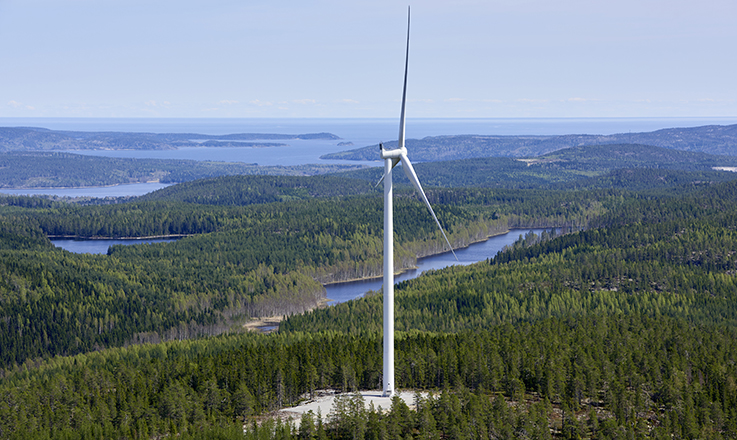
BayWa’s renewables arm has been commissioned by private forest owner Stora Enso to jointly develop several onshore wind projects on its land in Sweden.
BayWa r.e. and Stora Enso will work in partnership to develop more than 1.2GW of onshore wind capacity in central and northern Sweden.
“This partnership marks an important milestone in our portfolio strategy in the Nordics,” said David Rosberg, chief executive of BayWa r.e. Nordic.
“Together with Stora Enso, we can develop significant projects on land that is exceptionally well-suited for wind power, while also contributing to Sweden’s and the regions’ transition to renewable energy.”
BayWa r.e. Nordic is responsible for the development and implementation of the projects, which together comprise at least 158 wind turbines with a total capacity of just over 1.2GW.
There is potential to expand the collaboration to include solar power and battery energy storage systems (BESS).
Chief operating officer of BayWa r.e. Daniel Gäfke added: “Our expertise in project development and our proven track record in executing complex renewable energy projects demonstrate our commitment to driving the energy transition.
“I would like to express my thanks to Stora Enso for placing their trust in us – this partnership not only reflects our shared vision but paves the way for impactful energy projects in the Nordics.”
Stora Enso’s director of energy development Emil Thalin said: “As one of the world’s largest private forest owners, Stora Enso sees it as a natural step to contribute to the energy transition by making land available to realise the onshore wind power potential in Sweden.
“Together with BayWa r.e., we are now accelerating this effort by combining our strength as a landowner with BayWa r.e.’s extensive experience in renewable energy. This provides a solid foundation for developing sustainable energy projects that benefit society.”
The areas identified for development have been selected following an initial internal assessment by BayWa r.e. Nordic and are still in an early planning stage.
The next steps include establishing project organisations, conducting feasibility studies, as well as environmental and cultural heritage surveys. In addition, dialogue with municipalities and local communities will begin in preparation for the upcoming consultation processes.
The permitting process is planned to be completed within five years.