


Three French offshore wind farms can now halt production during periods of negative electricity prices, the energy transition ministry has confirmed.
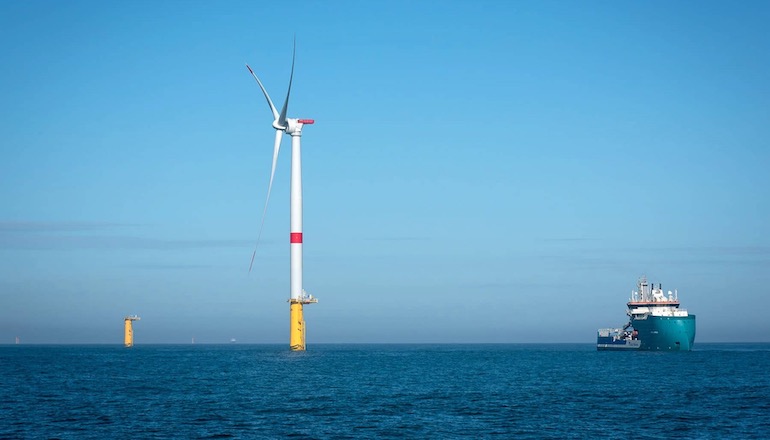
The Fécamp, Saint Nazaire (pictured) and Saint Brieuc projects have amended their power purchase agreements to allow partial or full shutdowns when electricity supply exceeds demand.
The ministry said the changes follow discussions with producers and are designed to reduce the cost burden on public finances and support grid stability.
The farms were built under purchase obligation contracts, which previously encouraged maximum output regardless of market conditions, the ministry said.
Under this model, electricity was bought at a fixed rate, even when market prices turned negative-resulting in losses when the power was resold.
The new clauses allow operators to suspend output and participate in the electricity adjustment mechanism, added the ministry.
The first shutdowns under the new rules took place during the weekend of 10–11 May.
The ministry said the changes aim to better align renewable generation with supply-demand balance in the electricity system.
Similar provisions have been introduced through the 2025 Finance Act for older, high-capacity onshore wind farms still under purchase obligation support.
A first decree to enable these producers to join the adjustment mechanism was submitted to the Higher Energy Council on 29 April.
A second decree is expected in the second half of 2025.
The ministry noted that newer support contracts are now mostly based on top-up payments rather than purchase obligations, except for the smallest installations.
This model encourages operators to suspend output when market prices are negative.
The ministry said the overall goal is to reconcile the growth of renewable energy with the real-time balancing needs of the electricity system.