


Orsted has cancelled development of its 2400MW Hornsea 4 offshore wind farm off east England, citing rising supply chain costs, higher interest rates and increased execution risk.
The project had secured a UK Contract for Difference (CfD) in September 2024 but will not proceed in its current form, the Danish developer said.
“Since the award, the project has seen several adverse developments relating to continued increase of supply chain costs, higher interest rates, and an increase in the risk to construct and operate Hornsea 4 on the planned timeline for a project of this scale,” the company stated.
“In combination, these developments have deteriorated the value creation of the project and increased the execution risk.”
“The combination of increased supply chain costs, higher interest rates, and increased execution risk have deteriorated the expected value creation of the project,” Orsted chief executive Rasmus Errboe added today on releasing the company’s first quarter results.
“We remain fully committed to being an important partner to the UK government to help them achieve their ambitious target for offshore wind build-out and appreciate the work they’ve done to deliver a clear framework to support offshore wind.
“However, our capital allocation is based on a strict and value-focused approach, and after careful consideration, we’ve decided to discontinue the development of the Hornsea 4 project in its current form, well ahead of the planned Final Investment Decision later this year.
“We’ve been maturing the project over the past nine months and have been working relentlessly with stakeholders and suppliers to manage the different project risks for a project of this scale.
“Throughout the development phase we’ve been very diligent in our approach to capital commitment to our suppliers, and our committed capital is well below our threshold. The adverse macroeconomic developments, continued supply chain challenges, and increased execution, market and operational risks have eroded the value creation.”
Errboe added: “I’d like to emphasise that Ørsted continues to firmly believe in the long-term fundamentals of and value perspectives for offshore wind in the UK. We’ll keep the project rights for the Hornsea 4 project in our development portfolio, and we’ll seek to develop the project later in a way that is more value-creating for us and our shareholders.”
The company said the decision aligns with its revised capital allocation framework and stage gate model, which prioritise early decisions to avoid escalating break costs.
The cancellation is expected to result in a Q2 2025 EBITDA impact of approximately Dkr3.0–3.5 billion (up to €470m), including a writedown of offshore transmission assets and provision for contract cancellation fees.
In addition, Orsted expects to impair capitalised construction costs of Dkr0.5–1.0 billion.
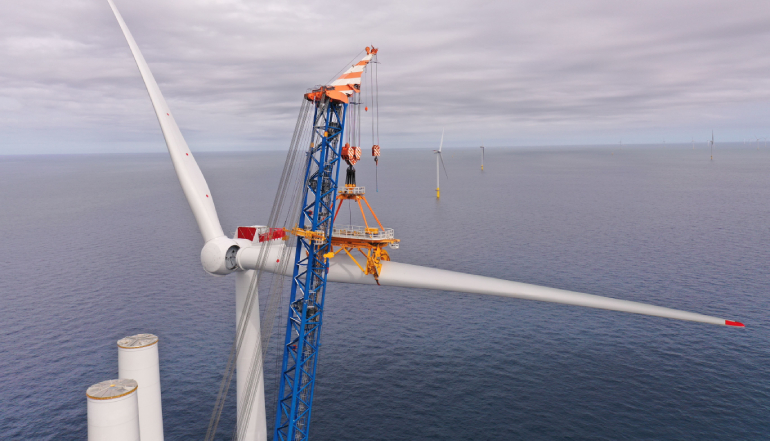
Hornsea 4 was planned as the latest stage of Orsted’s flagship Hornsea cluster off the east coast of England (pictured).
The company meanwhile posted operating profit (EBITDA) for the first quarter amounted to Dkr8.9 billion compared to Dkr7.5 billion in the same period last year.
Earnings from offshore sites amounted to Dkr7.7 billion (€1.2bn), which was an increase of Dkr700m compared to the same period last year.
The increase was due to the ramp-up of generation at its German offshore wind farm Gode Wind 3 and higher availability. This was partly offset by significantly lower wind speeds in the quarter.
“I’m pleased with our operational performance and earnings in Q1 2025, and we remain fully focused on the execution of our four strategic priorities,” added Errboe.
“During the quarter, we had solid operational earnings supporting our full-year guidance, and we continued to deliver on our farm-down programme by completing offshore and onshore farm-downs. We also continued to deliver on our construction portfolio as we commissioned our offshore wind farm Gode Wind 3 in Germany, reaching more than 10 GW of installed offshore capacity.”
In response to the move, RenewableUK’s deputy chief executive Jane Cooper said: “Although it’s disappointing when a project is put on pause, the UK remains one of the best places in the world to build offshore wind farms, with a significant pipeline, clear ambitions for contracting large volumes through upcoming auctions and supply chain funding.
“The unique cost pressures faced by Hornsea 4 have led to a rethink on this particular project, and we need to do everything we can to keep a stable market for all other projects going forward.
“The UK is still a global leader in offshore wind with the second largest amount of operational capacity in the world and the second largest pipeline of future projects.
“It remains one of the most attractive destinations for private investment, thanks to a positive policy framework put in place by the Government to ensure that offshore wind is at the heart of our future energy system, including a clear target to reach clean power by 2030, backed up by new reforms to planning.
“The fact that supply chain constraints have been cited as one of the reasons for this decision highlights the importance of investing to support the UK companies across the wind value chain as a central part of the UK’s industrial strategy.
“We urge the Government to remove uncertainty for investors in this year’s auction for new clean power projects by ensuring auction parameters reflect the cost increases we’re seeing in the supply chain and inflationary pressures.
“Additionally, Government should rule out the introduction of zonal pricing which would drive the cost of investment up even further.”