


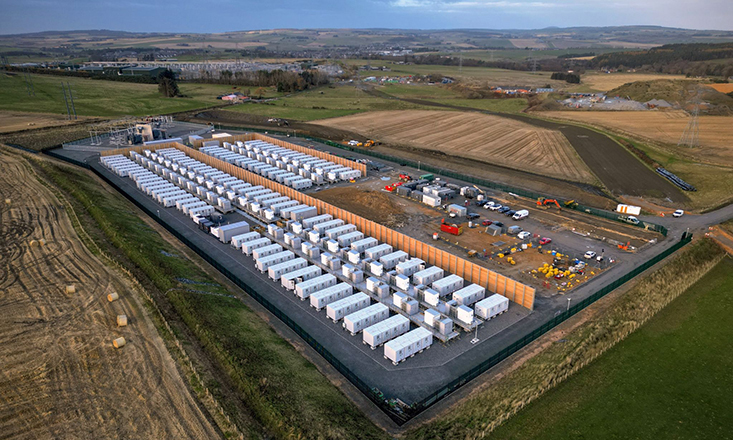
H&MV Engineering has completed electrical and civil works for the 200MW / 400MWh Blackhillock battery storage project in Scotland.
The battery energy storage system (pictured) developed by Zenobē is the largest BESS facility in Europe.
As principal designer and contractor, H&MV Engineering has delivered the complete electrical connection for the project.
The company’s scope of work included the design, procurement, supply, installation and commissioning of the 275kV and 33kV electrical network.
It was responsible for connecting the BESS to SSE’s 275kV transmission system and implementing protection schemes, interlocking, controls and metering systems.
In addition, H&MV had full site and project management responsibility.
The Blackhillock site is strategically positioned between Inverness and Aberdeen to address grid congestion from three major offshore wind farms.
The BESS is the world’s first battery facility to provide stability services to the National Energy System Operator (NESO), saving consumers over £170m and preventing 2.6 million tonnes of carbon dioxide emissions over 15 years.
The first phase (200MW / 400MWh) is now operational, with a second phase comprising an additional 100MW / 200MWh planned for 2026.
The total capacity of 300MW / 600MWh will power the equivalent of over 3.1 million homes for one hour
Blackhillock adds over 30% to Scotland’s operational battery storage capacity.
The site uses Wärtsilä’s Quantum energy storage system technology and GEMS Digital Energy Platform with SMA grid forming inverters.
This combination enables the system to provide stability services including short-circuit level and true synthetic inertia – essential for maintaining grid reliability as the UK phases out fossil fuel power plants.
Zenobē project engineering manager Tim Hewitt said: “We are pleased to have worked alongside H&MV Engineering in delivering the Blackhillock, Europe’s largest battery energy storage system.
“Their expertise and commitment as principal designer and contractor contributed to the success of this landmark project, driving progress toward a net-zero power grid by 2025.”