


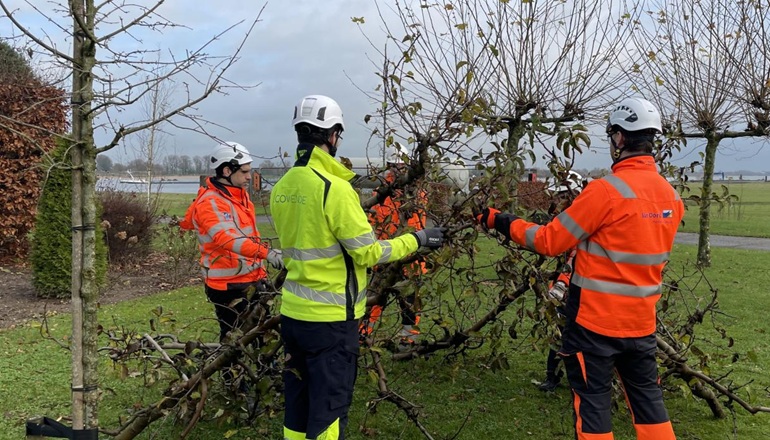
Van Oord and Ecowende have signed a contract for the design, construction and installation of Tree Reefs and Oyster Hubs at Ecowende’s Hollandse Kust West wind farm (HKW, site VI).
Implemented by Van Oord Ocean Health, these methods aim to naturally enhance biodiversity in the North Sea.
The contract marks a significant milestone, as it is the first time Tree Reefs will be implemented on such a large scale in the North Sea.
Tree Reefs are circular, biodegradable reef structures made from discarded fruit trees, which are relatively sturdy and stable.
The trees will be collected from the Dutch fruit cultivation sector and are usually cleared as soon as they start producing less fruit.
The Tree Reef concept was developed by the Royal Netherlands Institute for Sea Research (NIOZ).
NIOZ’s pilot in the Wadden Sea showed that the complex structure of fruit trees can offer marine life a highly valuable habitat.
A large North Sea Tree Reef is expected to create habitats for even more benthic and fish species, enhancing local biodiversity.
Van Oord and Ecowende will also collaborate on constructing Oyster Hubs at the wind farm.
This ecological innovation was developed in collaboration with Waardenburg Ecology.
The hubs consist of adult oysters of varying sizes placed on designated cable crossings to serve as a source of oyster larvae. The wind farm will function as a connection site, stimulating larval distribution to otherwise isolated locations and facilitating the colonisation of new areas.
Van Oord has already installed Oyster Hubs successfully at multiple offshore wind farms, such as Borssele 1 and 2 and Luchterduinen.
“As a partner of Ecowende, Van Oord is excited to bring innovative solutions such as Tree Reefs and Oyster Hubs to the Hollandse Kust West wind farm.
“This marks a significant step in our commitment to not only delivering sustainable offshore infrastructure but also enhancing biodiversity in the North Sea,” Karen Vennik, Commercial Director for Offshore Energy and Ocean Health at Van Oord
Van Oord plans to install the Tree Reefs in 2026 on four cable crossings in the Ecowende wind farm, with approximately 1000 trees forming the reefs.
They are expected to biodegrade underwater within 10 to 20 years, gradually being replaced by natural reef-building species.
The Oyster Hubs will be installed in 2026 or 2027 on three cable crossings.
Ecowende’s partner Waardenburg Ecology will measure and monitor the effects of these two innovations.
Jelle Muller, Ecology Project Engineer at Ecowende, said: ‘Insights and lessons learned from these two eco-innovations will be shared with the offshore and ecology communities to close knowledge gaps and accelerate the large-scale roll-out of offshore wind in harmony with nature.”