


Councillors in Wales have been given a glimpse of a new solar farm that will help a hospital on its journey to net zero.
Work has begun at the Coed Ely Solar Farm in south Wales, which has formed an innovative partnership with Royal Glamorgan Hospital.
As well as helping Rhondda Cynon Taf Council to reduce its carbon emissions, the solar farm will also provide clean energy for the hospital.
The project, built on a reclaimed colliery site, is being delivered by the council, with Vital Energi acting as the main contractor, supported by Hydrock and Rhomco.
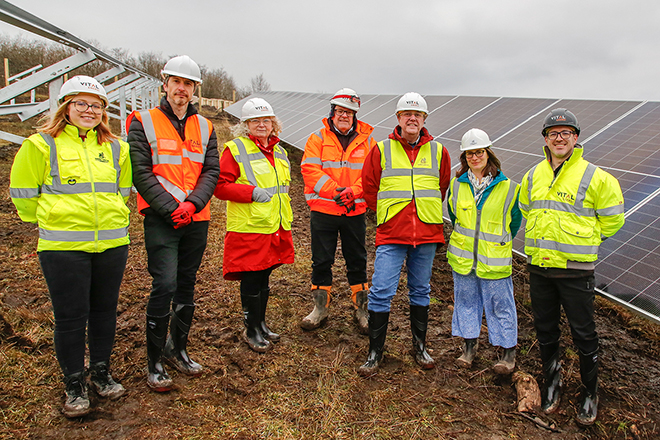
Councillors joined representatives from Cwm Taf Morgannwg University Health Board and Vital Energi to celebrate the commencement of works on the new 6MW plant (pictured).
When complete, the installation will include over 9,400 panels and be capable of generating 6MWh/year of electricity.
Crucially, it will play a key role in helping both Rhondda Cynon Taf Council and Royal Glamorgan Hospital by reducing emissions by over 7300 tonnes over the project’s lifetime.
Councillor Tina Leyshon, cabinet member for corporate services, youth participation and climate change, said: “It’s fantastic to see the progress on this project as we see the journey towards completing the Coed Ely Solar Farm begin.
“This ambitious project is providing a unique opportunity to deliver green energy at a significant scale, feeding energy directly into the National Grid and supporting the energy security of our community and the UK.
“By supplying the Royal Glamorgan Hospital with low-carbon electricity, we’re helping to reduce its carbon footprint, making the project even more beneficial and directly supplying our local NHS.
“Additionally, with the site’s reclaimed colliery tip unsuited for agriculture, this project shows how land can be repurposed for clean energy while still supporting local biodiversity.
“Grazing rights for animals will continue, demonstrating that solar energy projects can coexist with farming and enhance biodiversity.”
In total, 5MW of low-carbon electricity will be exported to the grid, while 1MW will be exported to Royal Glamorgan Hospital.
This means that on peak summer days, the whole hospital will be powered by solar energy.