


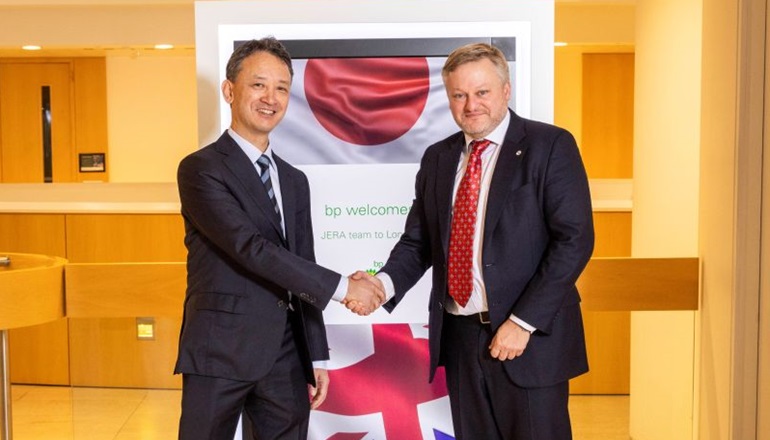
BP and JERA have agreed to combine their offshore wind businesses to form a joint venture that aims to become one of the largest global offshore wind developers, owners and operators.
The 50:50 company, JERA Nex BP, will have a balanced mix of operating assets and development projects with total 13GW potential net generating capacity, the companies said.
Formation of JERA Nex BP is intended to accelerate development from the combined pipeline and bolster access to competitive financing, they added.
Supporting this, the partners have agreed to provide capital funding for investments committed to before end of 2030 of up to $5.8bn.
The parties have agreed to work to complete formation of JERA Nex BP, subject to regulatory and other approvals, with completion expected by end of the third quarter of 2025.
JERA Nex BP will be based in London.
Its CEO will be nominated by JERA and the CFO by BP.
On completion, offshore wind teams from both JERA and JERA Nex and staff from BP’s offshore wind business will be expected to move into the new business.
The companies will contribute interests comprising operating assets with around 1GW net generating capacity, including the Formosa 1 site in Taiwan, a strong pipeline of high-quality development projects with around 7.5GW capacity, and further secured leases with around 4.5GW of potential capacity.
JERA Nex BP is expected to focus on progressing existing projects in north-west Europe, Australia and Japan and to continue to mature the development pipeline of significant longer-term opportunities.
Yukio Kani, CEO of JERA (Left), said: “Offshore wind has significant potential and is a critical component of the energy transition.
“The sector is at an inflection point, and we believe the transformative partnership launched today between our two companies combines the resources, capabilities, and network necessary to be a world-class offshore wind company, and in doing so, realise the potential of offshore wind globally, while positioning this business for long term success.
“Today’s announcement also demonstrates JERA’s commitment to the offshore business in Europe, Japan and the rest of the world and is a natural evolution of our strategy that places collaboration at the heart of our approach to renewables.”
Murray Auchincloss (right), BP CEO, said: “We are very pleased to have reached agreement with JERA to form a top five wind developer globally.
“This will be a very strong vehicle to grow into an electrifying world, while maintaining a capital-light model for our shareholders.
“We very much look forward to combining our strengths in Europe and Asia-Pacific to create another innovative platform.”
The two partners have agreed a clear funding framework for the rest of this decade that includes leveraging asset revenues and accessing competitive financing itself, as well as proceeds from portfolio management.
The equity investment contributed by the partners may be lower than the total agreed gross funding depending on project and venture financing and proceeds from asset farm-downs and sales.
JERA Nex BP is expected to benefit from the existing relationships and partnerships that the two shareholders have worldwide, including across the supply chain.
The business will also draw on and benefit from the global trading capabilities of both partners to manage and market power from its assets into various offtake channels.
JERA first entered the offshore wind market in 2019 through investments in projects in the UK and Taiwan. In 2023 it acquired Belgium offshore wind player, Parkwind, and later used this business as a platform to spin out a focused renewables vehicle, JERA Nex, created to pursue the renewables target in JERA’s 2035 growth strategy.
BP has been building a portfolio in offshore wind since 2019, and now has a development pipeline with total potential generating capacity of 9.7GW net (5.7GW development projects and a further 4GW secured leases).
Development projects are the Morgan and Mona projects in the UK Irish Sea, and Oceanbeat East and Oceanbeat West in Germany’s North Sea, with secured leases off Scotland and the east coast of the US.