


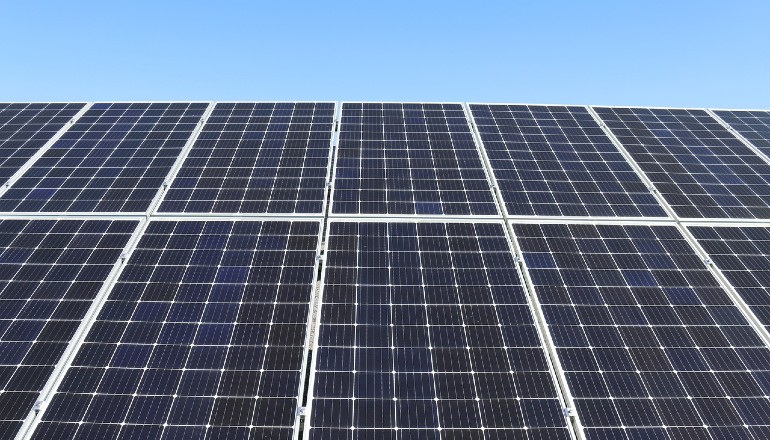
Solar Energy UK is calling on the government to triple the current solar generation capacity to 60GW by 2030.
The trade association highlighted an academic study which claimed that tripling the current solar capacity would significantly lower the cost of electricity.
It would also make delivering the government’s vision of clean power by 2030 more likely, according to the analysis conducted by Durham University Energy Institute.
Doing so while greatly expanding energy storage and flexibility would reduce reliance on expensive imports of natural gas, the analysis said.
It would also make the forthcoming Clean Power Plan less reliant on unproven carbon capture and storage technology, while cutting emissions and using more of our wind generation.
Solar Energy UK warned these benefits would be lost if the government relied too heavily on “out-of-date assumptions” recently presented by the National Energy System Operator (NESO). Doing so would stifle the growth of cheap, clean solar power, it said.
NESO’s two scenarios both had Great Britain reach 47.4GW of solar capacity by 2030.
In comparison, hitting 60GW – a third on rooftops, the rest on the ground – would result in 12% lower costs, according to the institute’s modelling, which uses a ‘digital twin’ of the UK’s electricity system.
Solar Energy UK said aiming for 60GW is not simply a more ambitious target but could act as way to de-risk the Clean Power Plan, guarding against slippage in delivery times from other parts of the plan.
The two NESO scenarios share a baseline of only 15.1GW of solar capacity being in place last year but Solar Energy UK said the true figure for the end of 2024 would be close to 20GW.
It also said the report failed to consider London’s plans to bolster generation on the roofs of homes and businesses, via the Warm Homes Fund, GB Energy, the Local Power Plan, the Future Homes Standard, Future Buildings Standard and retrofitting public buildings.
The trade association’s chief executive Chris Hewitt said: “Solar and batteries can be built very quickly, and in the next five years offer the government a huge opportunity to speed up its mission to deliver clean power.
“Setting a goal to treble solar to 60GW, rather than a de facto cap implied by the NESO advice, will deliver the lowest cost home-grown energy and thousands of secure jobs.
“We entirely agree that the grid connection process must change, as projects can get stuck in a queue for many years. But this needs to be done in a way that will allow ‘ready-to-build’ renewable energy to deliver this decade.”
Solar Energy UK has based its projections on engagement with its more than 400 members, alongside industry data.
They are based on there being 11.5GW of operational solar farms, alongside 8.5GW of capacity on residential, commercial and industrial rooftops in place now.
Meanwhile, 3GW of solar farms are being built and 11GW have planning consent. A gigawatt of rooftop capacity is also expected to be deployed this year.