


Wind software developer Whiffle has entered into a joint development agreement (JDA) with Orsted to enhance the accuracy of onshore wind flow modelling.
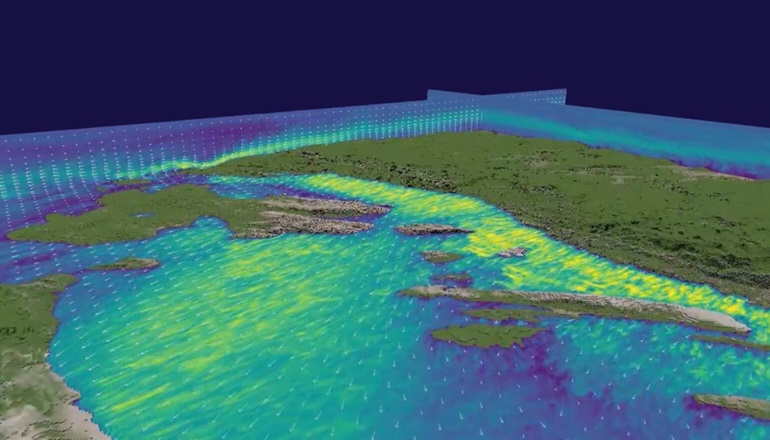
The partnership aims to further improve the accuracy of wind flow modelling (pictured) for wind projects, particularly in complex, forested terrains.
The focus will be on refining the model to align with Orsted’s operational needs.
The collaboration will focus on refining Whiffle’s Large Eddy Simulation (LES) model and seamlessly integrating its application into Orsted’s workflows.
Forested and mountainous regions are among the most difficult environments for accurate wind flow modelling due to the strong spatial variability in tree height, canopy density, and terrain features.
These factors create turbulent wind patterns and significant reductions in wind speeds, which traditional wind modelling tools, with their limited resolution, often fail to accurately capture.
The JDA between Whiffle and Orsted will improve the LES model by integrating detailed terrain and vegetation data, ensuring that wind simulations are more accurate and reliable in challenging onshore environments.
Andrew Davidson, Senior Energy Analyst at Orsted, said: “At Orsted, we continuously strive to improve our wind resource assessment through various initiatives.
“With wind being the very foundation for wind farm revenue, accurately predicting the available wind resource is crucial for developing a wind farm and building its business case.
“By partnering with Whiffle to enhance their Large Eddy Simulation model for onshore sites, where complex topography and forestry often present challenges, we aim to deliver commercial benefits for our onshore projects.”
Remco Verzijlbergh, CEO at Whiffle, added: “We’re very happy to be able to collaborate with Orsted in the coming period.
“This joint development is a pivotal step in strengthening our LES model to meet the demands of the most challenging onshore environments.
“By combining high-resolution data with our state-of-the-art simulation capabilities, we’re not just improving our model – we’re setting new standards for wind resource assessments that will directly impact the success and efficiency of onshore wind projects.”