


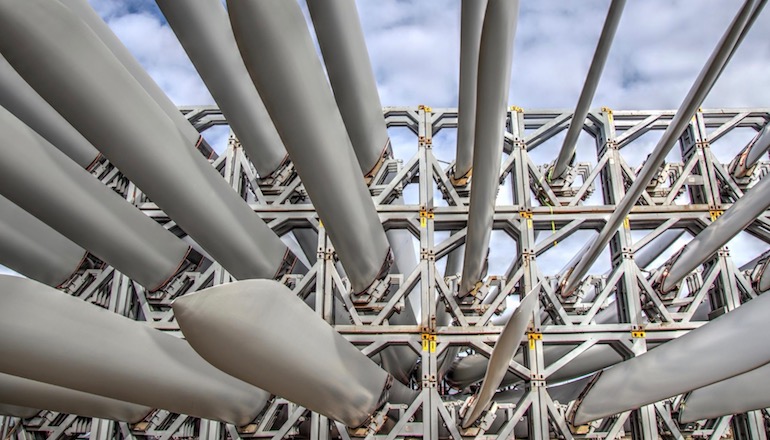
The National Composites Centre (NCC) has welcomed Scottish Renewables to its SusWIND Steering Board.
SusWIND is a collaborative innovation programme focused on creating a viable circular economy for wind turbine blades.
Launched in 2021 by the NCC, in partnership with the Offshore Renewable Energy (ORE) Catapult, the programme focuses on working to accelerate the development of technology, processes and materials that address the recyclability and future development of composite wind turbine blades.
As Scotland’s renewable energy trade body, Scottish Renewables represents organisations working on a wide range of renewable energy technologies including onshore and offshore wind, hydropower, hydrogen, low-carbon heat, solar, tidal and wave energy.
Director of onshore for Scottish Renewables Morag Watson said: “As an established, proven and critical part of the UK energy mix, sustainable wind offers a huge opportunity to increase UK energy security.
“Given Scottish Renewables’ leading role in the energy sector, collaborating with SusWIND for early supply chain intervention will accelerate the circularity of our renewable energy project pipeline.
“This will directly support the UK to meet net zero targets while helping us seize growth opportunities across the globe.”
As a SusWIND steering board member, Scottish Renewables joins industry advisors including the Crown Estate, Crown Estate Scotland, BVG Associates, RenewableUK, ZeroWaste Scotland, Net Zero Technology Centre and Vestas.
Collectively, they provide strategic guidance to a growing community of stakeholders in the composite industry and energy sector that work towards creating end-of-life value from past and current generations of turbine blades and embedding circularity principles at the heart of future generations of turbines.
SusWind brings together producers, suppliers and users in the wind industry of products made from composites, to look at every aspect of the turbine product lifecycle to achieve a sustainable future.
Members drive and define the scope of work for wind turbine blade end-of-life to reduce impact and increase circularity, which in turn, feeds powerfully into other sectors dependant on large structures, be it aerospace, defence or space.