


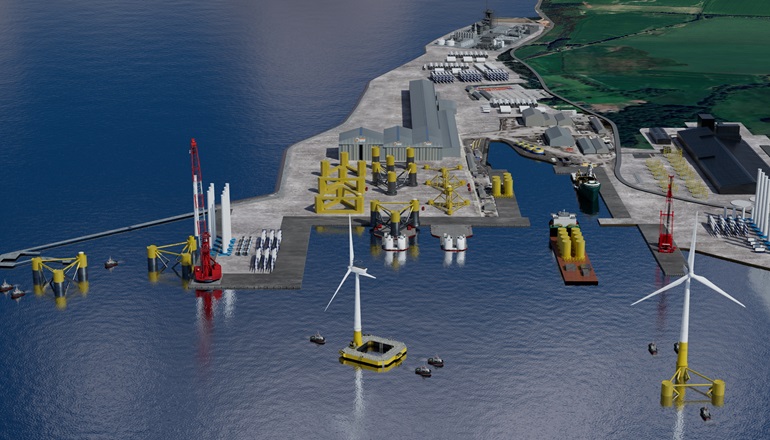
Apollo, Global Energy Group (GEG) and Offshore Renewable Energy (ORE) Catapult have published a study on the tow-to-port (T2P) operations for floating offshore wind turbines (FOWTs).
The study predicts that between 10 to 30 turbines may require T2P annually from 2035 to 2040, based on a review of bottom-fixed turbine failure data.
This could make T2P costs more significant than offshore installation and routine O&M costs combined.
Conducted from November 2023 to March 2024, the study addresses the operational challenges of transporting FOWTs to port for major maintenance.
The industry has an opportunity to prioritise the planning, management and mitigation of T2P to prevent significant bottlenecks, such as the limited availability of suitable vessels and cranes.
Apollo’s Lead Naval Architect, Will Brindley, said: “Understanding the challenges of T2P early helps developers to make better decisions.
“T2P cost and frequency can be significantly reduced with better planning to ensure the availability of essential resources at competitive rates.
“Innovative technology must also play a part by enabling more efficient offshore operations.
“Active investment, incentivisation and open collaboration across the floating wind industry are essential to make this a reality.”
Hrishikesh Atitkar, T&I Engineer at Global Energy Group, said: “The industrialisation of Floating Offshore Wind is set to revolutionise Scotland’s energy landscape, with enhanced port infrastructure essential to unlocking this technology.
“Global Energy Group are delighted to have collaborated in this critical T2P study, focused on optimised O&M strategies to ensure the competitiveness and long-term success of floating wind.
“As part of the study, we have been able to utilise our expertise from the extensive offshore wind track record developed at the Port of Nigg.
“Our facility has grown into a renewables superhub, having managed over 3.5GW of offshore wind assets and we continue to develop our capabilities to support future developments in the North Sea and beyond.”
The study was commissioned by ORE Catapult’s Floating Offshore Wind Centre of Excellence to help developers and the supply chain to inform their project financial planning and floating array infrastructure design.