


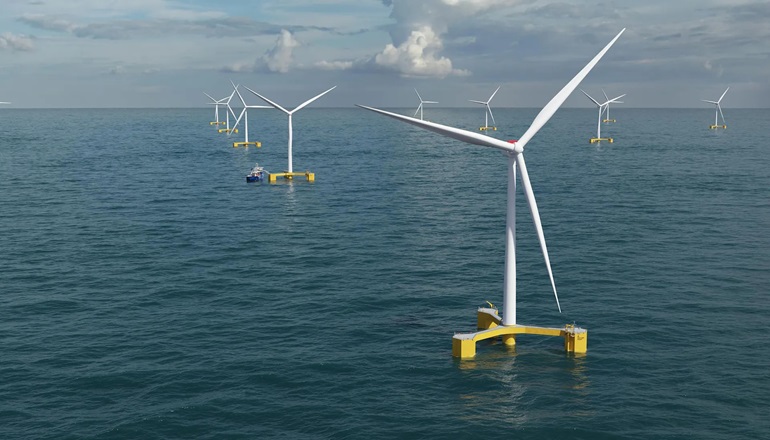
The California Energy Commission (CEC) has adopted its landmark Strategic Plan, creating a pathway to develop 25GW of offshore wind by 2045 to help California meet its climate goals.
The AB 525 Strategic Plan includes assessments and recommendations related to marine resources, sea-space planning, tribal engagement, fishery relations, permitting, workforce development, port development, and transmission.
The strategic offshore wind plan will now be submitted to the California Natural Resources Agency and the Legislature.
California’s AB 525, passed in 2021, directed the CEC to establish offshore wind goals for 2030 and 2045.
In 2022, the Commission set a goal of 25GW of offshore wind power generation by 2045.
It also required the Commission to develop the strategic plan released last month, with the goal of using offshore wind in pursuit of achieving 100% clean energy by 2045.
“We commend the California Energy Commission for its leadership in planning toward 25 GW of offshore wind by 2045,” said American Clean Power Association’s Pacific offshore wind director Molly Croll.
She added: “The approved plan outlines a pathway to scale up the offshore wind economy, advance port infrastructure upgrades, and facilitate transmission investments, reinforcing the crucial role of central procurement to spur these investments.
“ACP-CA stands ready to work with the State of California and all stakeholders on timely implementation of this plan to build out the offshore wind industry sustainably and to achieve our climate goals.”
Vice president of strategic communication at Oceantic Network Sam Salustro said: “The Oceantic Network and its West Coast Supplier Council thank the California Energy Commission for their extensive efforts to lay the groundwork for offshore wind in the Golden State and look forward to building upon and putting the final AB525 report into action.
“Floating offshore wind provides reliable clean energy at the scale needed for California’s clean energy transition.
“Already, California’s ambitious goal to deploy 25GW of offshore wind by 2045 has positioned the state as a global leader in this emerging energy sector, but achieving this bold goal requires scaling a new industry quickly.
“The state has a critical role to play in developing a viable industry and attracting a robust local supply chain by prioritizing immediate investments in port and transmission infrastructure, providing a long-term, predictable pipeline of projects, and targeting local supply chain investments that are globally cost competitive, rather than pursuing local content requirements that can delay project deployment and increase costs.”