


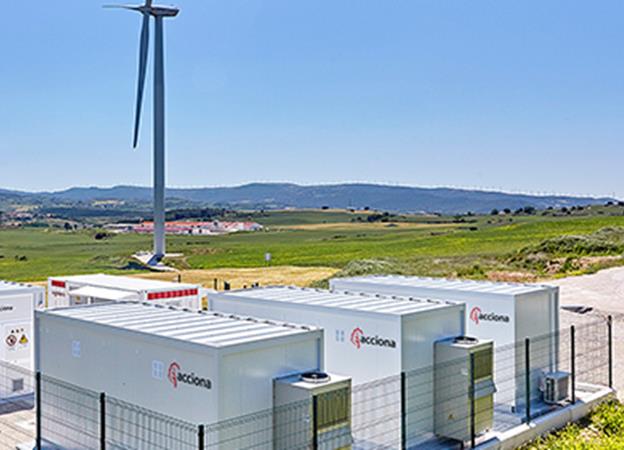
Great Britain, Germany the island of Ireland and Poland are the top four markets for renewable energy projects that co-locate with batteries.
Aurora Energy Research, in its inaugural European Renewables Co-location Report, examined 12 European countries which predicts an additional 421GW of intermittent renewable energy sources (RES) capacity by 2030.
This poses “significant risks” to RES assets, including cannibalisation of capture prices, increasing curtailment, and rising imbalance costs.
Germany, Greece, the Netherlands, and the Ireland I-SEM are the markets most affected by these drivers, incentivising co-location of RES assets with battery storage systems as a way for mitigation.
Co-location in Germany offers attractive revenue stacking opportunities, low grid fees, and mitigation of significant cannibalisation risk for RES, despite recent less appealing innovation auctions, according to the report.
Meanwhile Great Britain stands out due to favourable regulation, granting co-located assets access to multiple markets and offering faster grid access for co-located RES projects.
Resulting from high curtailment risks to renewables and beneficial legislation facilitating faster grid access, the Ireland I-SEM is rated high for co-locating RES and battery storage.
Additionally, Poland boasts a strong subsidy environment with cable pooling and access to long-term capacity market contracts.
Jannik Carl, Research Associate at Aurora Energy Research, added: “Market interest in co-locating intermittent renewables and battery assets has surged across Europe, with Great Britain at the forefront.
“However, policy frameworks in many markets lag behind, often focusing solely on individual aspects of co-located business models.
“To ensure successful projects in the years ahead, addressing the full complexity-including grid integration and market access-will be crucial.”
The report reveals that several European markets often lack co-location policy schemes.
In Germany, requirements imposed on the battery asset as part of the innovation auction scheme “drastically reduces” commercial viability.
Spain’s draft National Energy and Climate Plan (NECP) aims to increase battery storage targets to at least 2.5GW by 2030, with significant government grants allocated for co-located storage projects, but little capacity has been procured on a subsidy-basis in recent years.
The five markets rated as the most favourable in terms of policy and regulation are Poland due to accessibility to long-term capacity market revenues and novel cable pooling regulation, Hungary, which introduced mandatory co-location for solar assets above a certain size, the Ireland I-SEM and Great Britain due to the variety of available revenue streams for projects and potential benefits in terms of grid access and curtailment risks.
France is also considered an attractive market for the co-location of solar and battery storage, as co-located solar can participate in French Contract for Differences (CfD) auctions, which have historically cleared at high strike prices.
Recent announcements in Spain regarding potential capital expenditure (CapEx) support for co-located batteries could offer a substantial boost to business cases.
Ongoing discussions in the Netherlands concerning battery storage obligations and potential reductions in grid fees could also enhance business cases and project pipelines.
Rebecca McManus, Senior Research Associate at Aurora Energy Research, said: “With intermittent renewables playing an ever more important role in the European energy landscape and the recent uptake of batteries, co-located projects will soon become an essential part of developers’ work.
“However, each asset type is challenging to navigate on its own and managing the interplay of both asset classes and how to operate them together, will remain an obstacle.”