


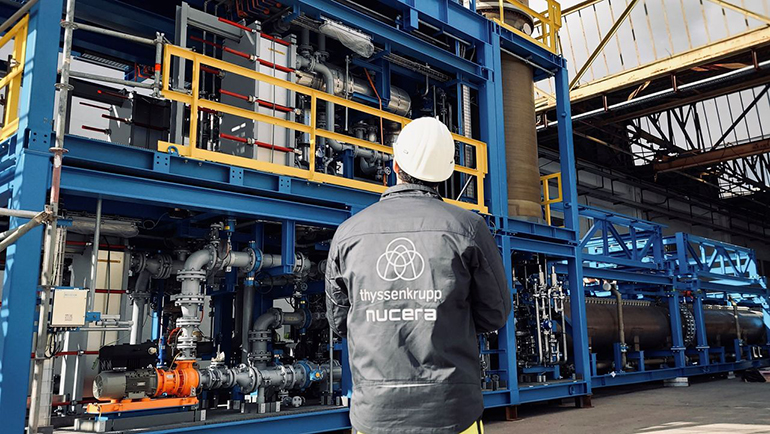
Spanish energy company Cepsa has selected Thyssenkrupp Nucera as preferred supplier of 300MW of electrolysers and Siemens Energy for the supply of 100MW of Proton Exchange Membrane (PEM) electrolysis technology for a green hydrogen plant in southern Spain.
Thyssenkrupp Nucera received the award to provide a basic engineering design package, utilizing Scalum modules, for the first phase of the former’s green hydrogen project at La Rábida Energy Park in Palos de la Frontera, Huelva, which it is developing in partnership with Fertiberia.
Under an agreement announced at the World Hydrogen Summit in Rotterdam, Thyssenkrupp Nucera will assist in the design and engineer of the facility through to the final investment decision.
The project will use 15 of German outfit Thyssenkrupp’s standardized Scalum electrolyser units with a capacity of 20MW each.
The PEM electrolysis from Siemens Energy will complement the use of alkaline water technology and the decision to use both technologies is part of a multi-supplier approach to creating a European value chain for green hydrogen, an essential vector to decarbonize industry and heavy ground, air and maritime transport across the continent this decade, said the developer.
With a production up to 47,000 tons green hydrogen per year, it will form part of Cepsa’s wider plans to develop 2GW of green hydrogen capacity in southern Spain by 2030.
“We are very pleased to be working with an innovative partner to create one of the largest hydrogen valleys in Europe and to contribute to Cepsa’s path to a gigawatt capacity,” said Thyssenkrupp Nucera chief executive Werner Ponikwar.
Cepsa’s executive vice president of commercial and clean energies Carlos Barrasa said: “This is a decisive step in our Positive Motion strategy as we move to become a leading producer of green hydrogen developing vitally needed clean energy solutions for industry and heavy transport in Spain and across Europe.
“Our agreement with Thyssenkrupp Nucera brings together leading European businesses to create a European green hydrogen supply chain and accelerate decarbonization across the continent.
“Cepsa continues to execute important strategic agreements to develop the Andalusian Green Hydrogen Valley, enabling us to bring crucial green molecules to our customers as we support their decarbonization journeys.
“Produced at scale, green hydrogen can power Europe to a zero-carbon energy system. Through a combination of electrolyser technologies, Cepsa can manage technology risk to ensure supply for our customers.”
The electricity required for the production process is to come from solar and wind energy, which is plentiful in southern Spain, making it one of the most competitive places in Europe for green hydrogen production, said Cepsa.
The region also has access to strategic ports, forming the basis for the maritime corridor the developer has set up with partners to transport hydrogen between southern and northern Europe, ensuring decarbonization solutions across the continent, it added.
“Thyssenkrupp Nucera’s alkaline water electrolysis developed with our engineer’s industrial DNA is again the key to transform renewable energy into green hydrogen to decarbonize hard to abate industries,” said the company’s head of green hydrogen Christoph Noeres.
“This project with Cepsa once again demonstrates the strong confidence of leading industrial players in our technology.”
Head of sustainable energy systems at Siemens Energy Alexey Ustinov, said: “We are delighted to be part of Cepsa’s ‘Green Hydrogen Valley’ project, as there will be no energy transition without green molecules.
“The industry is ready, production capacity of electrolyzers is no longer the bottleneck in ramping up the hydrogen economy.
“Our Berlin multi-gigawatt electrolyzer factory is a good example of this. But we need a faster pace of funding approvals and fewer technocratic hurdles to ensure that such projects can make their decisive contribution to decarbonization across Europe.”