


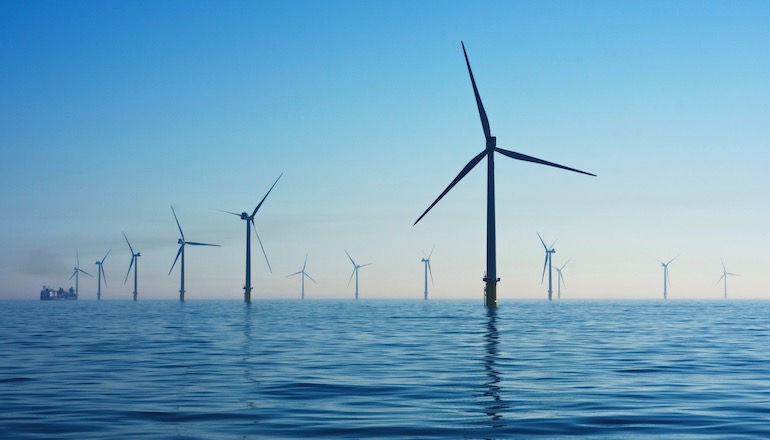
Governments and the offshore wind industry need to join forces to restore confidence in the market, drive down costs and accelerate the clean energy transition, according to a new briefing from the Energy Transitions Commission (ETC).
The ETC’s membership includes offshore wind industry players BP, Iberdrola, Octopus Energy, Petronas, Shell, SSE, Vattenfall, and Orsted.
Offshore wind is already delivering large-scale clean electricity at a competitive cost around the world.
According to Overcoming Turbulence in the Offshore Wind Sector, costs fell 60% between 2015-2022 in Western Europe.
Installations are growing rapidly. From 2015 to 2023, global capacity has expanded six-fold from 12GW to 74GW, already producing energy for around 90 million households, and with vast potential to scale further.
But in 2022-2023, inflation, supply chain bottlenecks, and higher interest rates led to rising offshore wind costs in some markets, ETC said.
A perceived offshore wind “crisis” ensued, in the UK and US markets in particular, as many projects and contracts were cancelled.
While increases were significant, they are mostly expected to be short-term, ETC said.
ETC chair Adair Turner said: “Offshore wind is vital for the clean energy transition.
“It can generate electricity when the sun isn’t shining and doesn’t compete for land use.
“Now is a critical period to rapidly accelerate wind capacity if the world is to achieve net-zero emissions by mid-century.
“Governments should act now to restore market confidence by setting ambitious offshore wind targets and design auctions and contracts which provide market certainty and drive costs down.”
Governments and industry must closely collaborate to relaunch confidence in offshore wind markets and bring down costs, according to the briefing.
To be on track to install the capacity required for the transition to clean electricity, the ETC recommends authorities should set ambitious targets and predefined auction schedules, which ensure large-scale volumes committed and delivered year by year.
They should also design auctions and government-backed contracts to reduce the risks of non-delivery.
Changes should include inflation-indexation to reduce developer risks and greater penalties for withdrawing from contracts to reduce contracts being treated as options.
Governments must accept paying somewhat higher prices to remove this optionality, ETC argued.
In addition, they should streamline planning, permitting and grid connection processes while also reinforcing the grid to reduce waiting times for offshore wind to connect.
Furthermore, governments need to ensure turbine and component production can achieve economies of scale-based cost reductions by encouraging harmonisation of hardware parts and sizes.
Finally, they should address specific supply chain bottlenecks through, for example, guarantees and subsidies for new installation vessels to carry larger turbines; and balancing the desire to encourage local supply chain content with the need to achieve high production volumes on a multi-country/regional level.
Overcoming Turbulence in the Offshore Wind Sector has been developed in collaboration with ETC members from across industry, financial institutions, and environmental advocacy.