


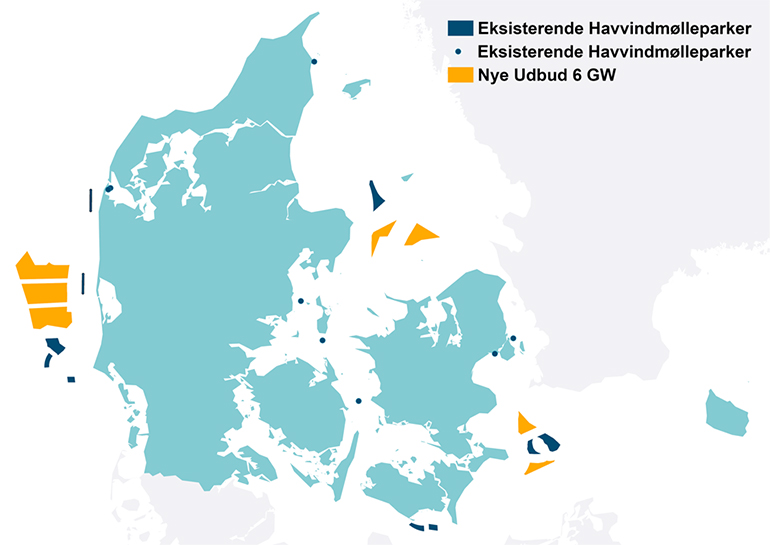
The Danish Energy Agency has published 6GW of tender frameworks across 6 offshore wind farm areas.
It said that this is the biggest offshore wind tender in Danish history.
The green power produced will be used not only for Danish consumption, but also for export to neighbouring countries and for green hydrogen production.
The tendered wind farms are located in the areas: North Sea I, Kattegat, Kriegers Flak 2, and Hesselø.
The tenders follow the political agreement on tender frameworks from the spring of 2023.
The offshore wind farms must deliver at least 6 GW, and as a new element, there will be freedom to establish as much offshore wind as possible on the tendered areas (with the exemption of Hesselø with a max. capacity of 1.2GW).
DEA said that If the market utilises this freedom to optimise the usage of the areas, it could result in the construction of 10GW offshore wind or more.
- A number of requirements will be implemented in order to ensure increase sustainability and social responsibility in the projects.
- The 6 GW will be tendered without state subsidies and with a yearly concession
- payment. This means, that the bidders will participate in the tenders by bidding a
- yearly concession payment to the Danish state across a 30-year period, for the right
- to use the seabed.
- The concession payment is combined with the Danish state co-owning each of the
- tendered offshore wind farms with a minority ownership of 20%.
When the wind turbines are operating, all of Denmark’s power consumption would be covered by green electricity and it could also produce hydrogen and green fuels for ships and planes.
Minister for Climate, Energy, and Utilities, Lars Aagaard, said: “We have paid close attention to the input from the market ahead of the tenders.
“Now it is up to the market to bid on and realise the projects.
“Companies have to place their bids on wind farms with the price of what they are willing to pay every year to the Danish state over a 30-year period.
“Each winner will win the right to construct offshore wind in the designated areas.
“Additionally, the Danish state will be co-owners of 20% of the established offshore wind farms.
“Now it is up to the market to take part in Denmark’s next big wind adventure.
“The next chapter will thus be written and carried out by the market – it is the market that must bring these tenders across the finish line.”
Construction of an offshore wind farm of this scale brings massive investments and thousands of green jobs.
An offshore wind farm with 1GW capacity is expected to require capital investments of around DKK16bn (€2.1bn), and, according to calculations from market actors from 2020, approximately 9,500 workers.
Not all of these jobs will be in Denmark, but the 6GW offshore wind can contribute substantially to employment across Denmark – especially in the construction phase.