


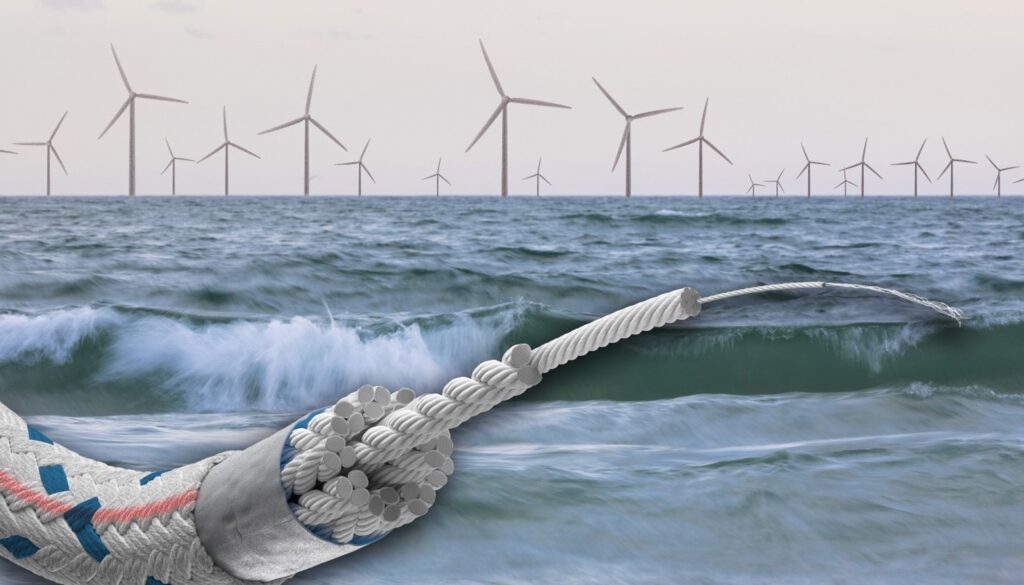
Belgian steel wire manufacturer Bekaert has joined the Tailwind project to develop floating offshore wind mooring solutions.
Launched in January 2024, the Tailwind project aims to deliver advanced station-keeping technologies, designed to maintain the position of floating offshore wind energy farms through innovative mooring lines and anchoring systems.
The development of these technologies is critical to open new paths towards the global effectiveness and sustainability of floating offshore wind farms, driving tangible cost savings while reducing dependency on primary raw materials, Bekaert said.
A global market and technology leader in material science of steel wire transformation and coating technology, Bekaert also develops beyond-steel solutions with its Scottish-based synthetic rope manufacturing facilities.
Bekaert was invited to join the Tailwind consortium for its experience in offshore mooring systems, the company said.
Christof Dewijngaert, general manager synthetics at Bekaert, said: “I am very pleased that Bekaert is involved in the Tailwind project that will further enable the growth of floating offshore wind which plays an important role in accelerating the generation of clean, sustainable energy.
“With our track record in mooring systems for offshore oil and gas, we are committed to contributing to enabling the scale-up of more optimal station-keeping concepts and systems for floating offshore wind.”
A wide range of stakeholders will be engaged in the Tailwind project to investigate the acceptance of potential new technologies to act as a catalyst for increasing affordable wind power in the energy mix.
Tailwind also targets a significant reduction of the levelised cost of electricity (LCOE) produced by floating offshore wind farms thanks to the higher cost-efficiency of the new mooring and anchoring solutions, avoiding bottlenecks and major dependency on the supply chain.
The Tailwind consortium is composed of NGI – Norwegian Geotechnical Institute (Norway), Technische Universiteit Delft (Netherlands), Danmarks Tekniske Universitet (Denmark), SINTEF Ocean AS (Norway), Fundación Tecnalia Research & Innovation (Spain), Nautilus Floating Solutions (Spain), Bekaert (Belgium), Subsea 7 Norway AS (Norway), Fondazione ICONS (Italy), Clarke Modet Y Compania S.L. (Spain), NKT Cables Group A/S (Denmark), University of Southampton (UK).
The Tailwind project, funded by the EU’s Horizon Program, contributes to the goals set by the “REPowerEU” Plan and the “Fit for 55” package, aiming to accelerate the roll-out of renewables, diversify energy supplies and trigger consistent energy savings.