


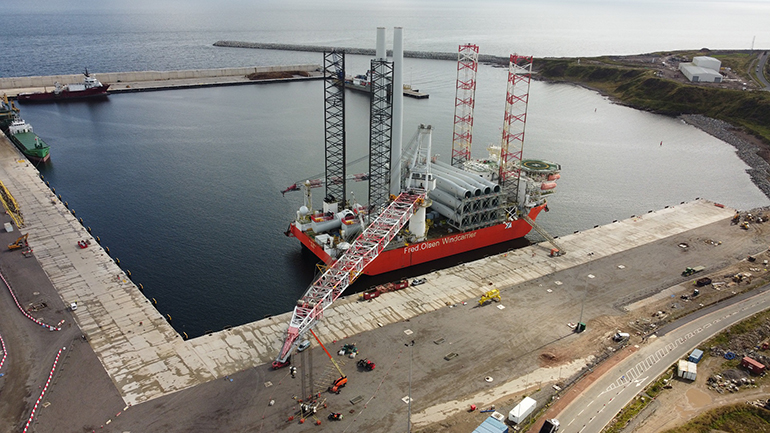
Port of Aberdeen is a step closer to becoming a strategic hub for floating offshore wind, with its proposed South Harbour upgrade project progressing to Stage 2 ‘priority’ status in the Scottish Offshore Wind Energy Council’s (SOWEC) Strategic Investment Model (SIM).
The upgrade involves a capital dredge project to deepen 750 metres of quayside to -14.5 metre chart datum, providing suitable depth for the majority of ScotWind and INTOG project turbine designs.
Combined with South Harbour’s expansive laydown area and ultra heavy-lift capacity, the facility will support turbine integrations and foundation assemblies. Looking further ahead, it also positions the port to handle major component exchanges with tow-in, tow-out operations.
The project was one of seven supply chain schemes added to the three schemes SOWEC had already selected for priority assessment in the SIM funding round.
As Scotland’s largest berthage port, offering 7600 metres of quayside across its North and South Harbours, Port of Aberdeen has the potential to become the largest operations and maintenance base for offshore wind.
Last year alone, the port handled more than 700 vessels associated with offshore wind projects, highlighting the increasing demand from both existing and planned Scottish offshore wind developments.
Strategically located within 100 nautical miles of 75% of the ScotWind licences, Port of Aberdeen is at the heart of a growing renewable energy cluster. The port is the marine gateway for Energy Transition Zone Ltd and closely located to Offshore Renewable Energy Catapult’s world-first Floating Offshore Wind Innovation Centre.
“SOWEC’s prioritisation of the South Harbour upgrade is a significant vote of confidence from both the Scottish government and industry in our £420m expansion,” said Port of Aberdeen chief executive Bob Sanguinetti.
“Upgrading South Harbour for floating offshore wind will ensure the unrivalled energy supply chain in Aberdeen and wider north-east of Scotland can maximise the opportunities presented by ScotWind and INTOG.
“We’ll continue to make the case to the Scottish government, UK government, and industry that this is an opportunity that cannot be missed.”