


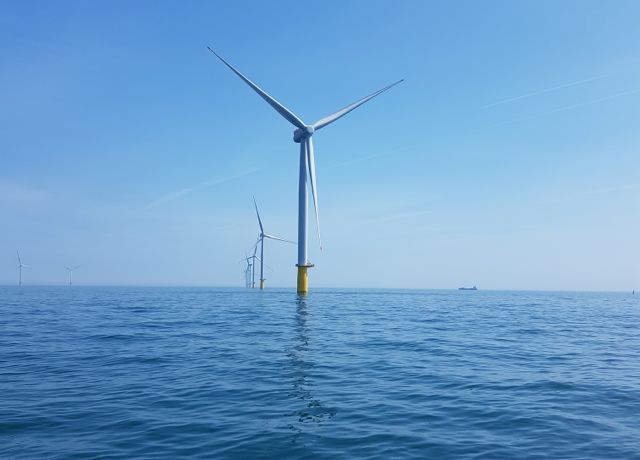
Eolus has submitted an application for the 1GW Blekinge Offshore wind farm, 11km off the coast of Blekinge, southern Sweden.
The site located within the municipalities of Karlshamn and Sölvesborg, comprises up to 70 turbines with a production of approximately 4.3TWh of renewable electricity per year.
The application for an environmental permit has now been submitted to the Land and Environment Court in Växjö. An application to conduct investigations on the seabed and lay underwater cables has also been sent to the Ministry of Climate and Enterprise. The applications, including an environmental impact assessment with accompanying investigations, will be sent out for consultation to concerned stakeholders before a decision on the permit is made.
Construction is due to begin in 2027.
“The technical conditions are incredibly good with shallow waters and proximity to the power grid, which allows us to build with existing technology,” said Eolus chief executive Per Witalisson.
“This makes Blekinge Offshore an optimal project for those who want more electricity production and lower electricity prices in southern Sweden.”
Blekinge Offshore is owned by Eolus and the local company Vingkraft, which initiated the project.
“We are now submitting a completely revised application to build Blekinge Offshore. The project is important for the future of the region, and we can build it without compromising the living creatures and valuable environments that exist in the sea,” said Blekinge Offshore chief executive Anders Nilsson.
The wind farm is about 11km from the mainland, and about 5km east of Hanö, in an area identified as suitable for energy production in the coastal plans of Blekinge’s coastal municipalities.
In 2016, the Swedish government rejected an earlier application in the area, citing the interests of the Swedish Armed Forces. The objections then were centred around concerns the previous project area encroached on parts of a marine training area and the distance between the turbines was too small.
Since 2021, a new project has been developed with 40% less area, 90% fewer units, and a quadrupled distance – which means 2km – between them. Further measures to accommodate the Swedish Armed Forces have been developed in regional collaboration.
“Together with the Blekinge Region and the municipalities of Kristianstad and Simrishamn, we have opened up to offer the Swedish Armed Forces an extended area for marine exercises in Hanö Bay,” said chair of the Municipal Council in Sölvesborg Birgit Birgersson-Brorsson and vice chair of the Municipal Council in Sölvesborg Kith Mårtensson.
“Our proposal for an expansion of 770 square kilometres corresponds to an area five times larger than Blekinge Offshore. From the perspective of the coastal municipalities and the region, we are very eager for the project to proceed.”
Regional director of the Confederation of Swedish Enterprise in Skåne Johan Dalén added: “We must stop putting different types of energy against each other and instead embrace every kWh that we can produce ourselves in electricity price area 4 – regardless of how it is produced. In this way, we create jobs instead of risking losing investments and establishments due to uncertainty in electricity supply and higher electricity prices than surrounding regions.”
During a press conference in Nogersund on Monday morning, local fishermen were also present.
“Blekinge Offshore does not encroach on fishing. Rather, it becomes a very good nursery habitat for fish that like to hide by the foundations,” said local fisherman Lennart Arvidsson.