


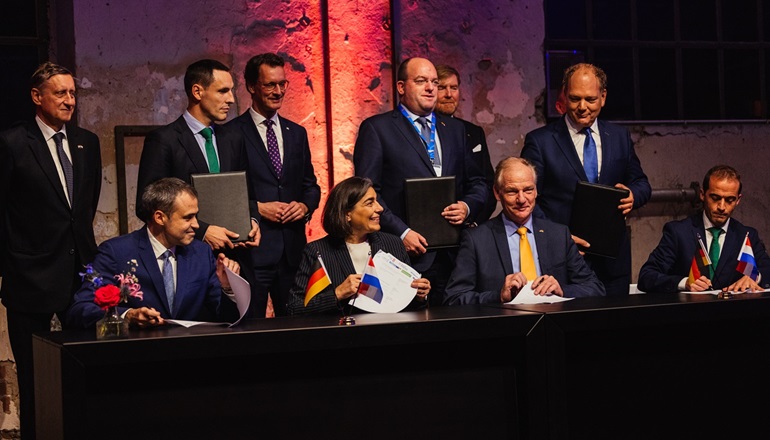
Spanish, Dutch and German ports have signed a memorandum of understanding (MoU) to explore the development of an intra-European corridor for renewable hydrogen.
Port of Bilbao, Port of Amsterdam and Duisport, together with the Energy Agency of the Basque Government, Petronor, Evos Amsterdam and Zenith Energy Terminals, are the MoU’s signatories.
The end-to-end corridor will connect Spain, the Netherlands and Germany and it will help the EU to achieve its ambition of establishing intra-European corridors for clean hydrogen.
The MoU builds on an agreement concluded earlier this year between Bilbao and Amsterdam, with the specific aim of initiating a viable corridor that allows for Basque produced renewable hydrogen and hydrogen derivatives to be exported to the port of Amsterdam for local offtake.
With the addition of Duisport, this corridor can be extended, with port of Amsterdam transforming into the gateway to the German market, opening up the possibility to supply Basque hydrogen to the large industrial offtakers located in the Rhine-Ruhr region.
As part of their cooperation, the parties will focus on production of renewable hydrogen by Petronor in the Basque Country, identification of offtake potential and demand centres in Duisburg and its surrounding industrial regions, as well as an evaluation of transportation, storage and distribution methods to provide solutions to secure the supply of renewable hydrogen and its derivatives to the respective end-users.
Andima Ormaetxe, Director Operations, Commercial and Logistics of Port of Bilbao, said: “It is our aim to become carbon neutral by 2050 and therefore green corridors between Bilbao, the Netherlands and Germany are of importance to help decarbonise, not only the Basque Country Industry, but also other industrial regions within Europe.”
Markus Bangen, CEO of duisport, said: “By expanding this trusting cooperation, we are sending an important signal for cross-border collaboration: only by working together we can master global challenges such as the energy transition and quickly develop a Europe-wide hydrogen network.”
Dorine Bosman, Chief Investment Officer at Port of Amsterdam, added: “The port of Amsterdam has a key role to play as a conduit for hydrogen and e-fuels to the Rhine-Ruhr area.
“This supply is of vital strategic importance on a European level, which is why our shared focus with Duisport on the resilience of the supply chain is crucial.
“This way, we can bring a corridor for hydrogen and e-fuels between a strong production region like the Basque Country and the port of Duisburg to life.”