


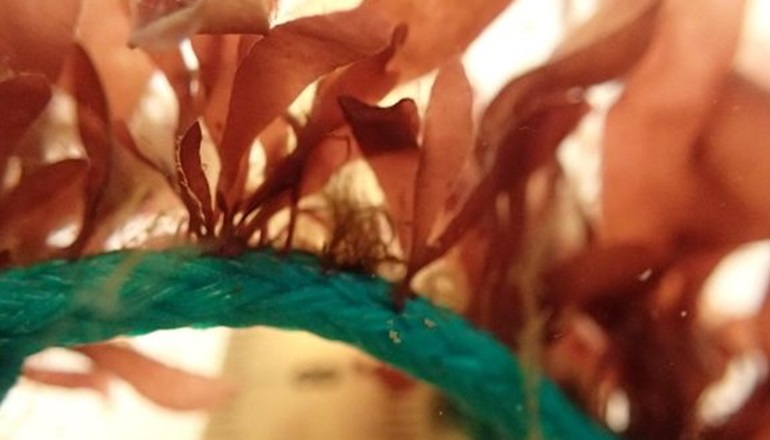
A research project at Orsted’s Anholt offshore wind farm off Denmark aims to grow a number of less carbon-intensive foods while contributing to a healthier marine environment.
Seaweed is critical to the project’s objectives as it is highly effective at sequestering carbon dioxide and nutrients whilst creating new habitats for marine species.
Ingrid Reumert, Senior Vice President and Head of Global Stakeholder Relations at Orsted, said: “We’ll be constructing a lot of offshore wind farms over the next several years.
“If we can use the same areas at sea which are already being used to generate renewable energy to produce new, climate-friendly foods such as seaweed and mussels while simultaneously protecting the marine environment, we can really make a difference.”
As part of the ULTFARMS project, researchers from the Technical University of Denmark (DTU) are putting out lines of up to 100 metres – in sometimes very windy conditions – in the water around the 111 wind turbines that make up Anholt Offshore Wind Farm.
Seedlings attached to the lines will cultivate three different types of seaweed which can be used for human consumption.
Next spring, the plan is to start the cultivation of blue mussels by supplementing the seaweed with material that mussel larvae in the seawater can settle on.
Jens Kjerulf Petersen, professor at DTU, said: “Seaweed is a plant that absorbs carbon dioxide directly, while cultivating mussels requires very little energy – they feed on what’s already in the sea, which is why they’ve been selected for this project.
“The area around Anholt has been chosen because the water has the right salinity for cultivating mussels and seaweed.”
Anholt is owned by Orsted, PensionDanmark and PKA.
The hope is that projects like these will show that it is possible to integrate the marine environment into the design of renewable energy projects early on, thereby enabling faster administrative processes and consenting times for a sustainable build-out of offshore wind.
Jan Kæraa Rasmussen, Head of ESG & Sustainability at PensionDanmark, said: “Offshore wind is a key to a green Europe independent of Russian gas, and we need to build at a scale never seen before.
“At the same time, the marine environment in Denmark is under pressure, and it therefore makes sense for us as responsible investors to engage in projects that investigate how we can ensure a build-out of renewable energy that isn’t only climate-friendly but also nature-friendly.
“And with this project, we’ll add a new dimension to the narrative about Anholt Offshore Wind Farm as an innovation hub – both for large-scale offshore wind deployment and for a future healthy and vibrant marine environment around Denmark.”