


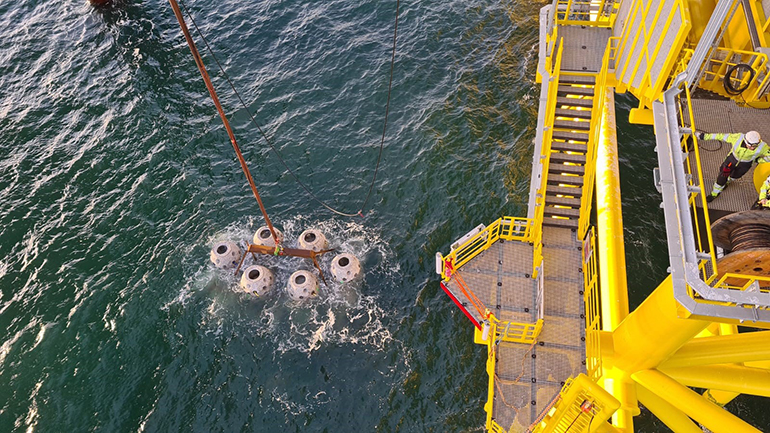
TenneT has installed several artificial reefs near the offshore transformer platform Hollandse Kust West Alpha to gain further knowledge about nature-inclusive construction.
The platform will connect the Ecowende consortium (Shell/Eneco) wind farm to the high voltage grid.
Working in collaboration with contractor Equans/Smulders, the aim is to build the site with a healthy ecosystem and as little impact on nature as possible. The artificial reefs are part of a series of ecological measures by TenneT to monitor and encourage underwater life around offshore wind farms.
“We are aware of the potential impact on the North Sea,” said head of offshore development at TenneT Saskia Jaarsma.
“That’s why we pay a lot of attention in researching what happens underwater. The installation of artificial reefs is another step in researching, monitoring and stimulating marine life.”
Two types of artificial reefs have been placed near the Hollandse Kust west alpha jacket, located about 50km off the coast of Egmond aan Zee.
Earlier, similar structures were placed at the TenneT platform at Hollandse Kust north.
Six reef cubes are attached to one frame. These are hollow square blocks made of nature-friendly recycled materials with round holes in the walls.
On the other steel frame are six reef balls, a similar structure but in the shape of a ball.
“These artificial reef structures are meant to stimulate marine life,” said marine biologist and TenneT advisor Annemiek Hermans.
“With these, you create potential spots where coral and algae settle. Earlier research shows that fish, crabs and lobsters like to visit these spots for shelter and to look for food.”
The aim of the trial is to investigate which shape – ball or cube – works. The hollows provide protection for young fish, but are also meant to increase the structure’s bonding surface.
“In this way, we hope to provide a suitable place for numerous other animal and plant species in addition to juvenile fish, crabs and lobsters,” Hermans said.
Jaarsma added: “Only in this way can you gain the necessary knowledge and experience to build nature-inclusively. Otherwise you never find out what the success rate of a measure is.
“These pilots are relatively intensive to realise, but of great value for ecology. For example, the first effects of the ecological cable crossings at wind farm Hollandse Kust zuid are already surprisingly good, we see a lot of life developing there.”
Hermans expects that it takes up to three years to see clearly visible differences.
“Until then, we monitor annually whether the diversity of life forms around the artificial reefs and fish hotels increases,” she said. “Fish lose scales and cells, for example, and faeces also end up in the water. By reading DNA in water samples, you can find out pretty quickly which guests have checked in.”