


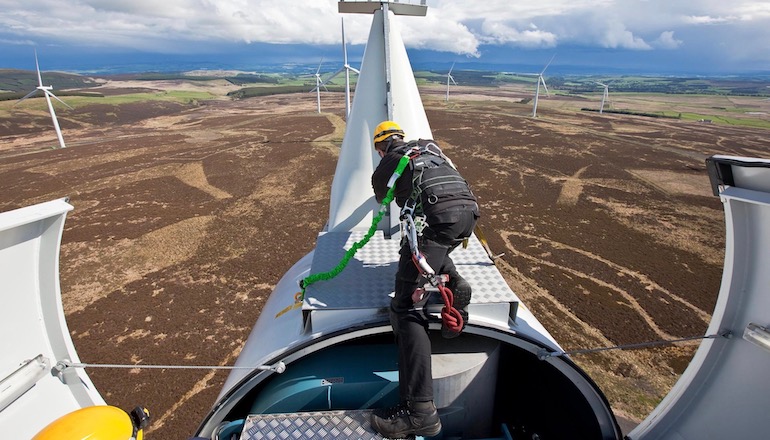
New figures clarify the workforce challenge facing the global wind industry with nearly 600,000 technicians needed during the next five years, according to GWO and GWEC.
More than 240,000 of these roles will be new recruits to the industry.
GWO and GWEC’s latest joint report forecasts the numbers of wind technicians required to construct, install, operate, and maintain (C&I and O&M) the anticipated global wind fleet up to 2027.
This report highlights the opportunities for local and national governments to leverage renewable energy expansion to foster job, training and reskilling opportunities and create a skilled workforce for the energy transition.
The Global Wind Workforce Outlook 2023-2027 sets out that over 574,000 technicians will be required for C&I and O&M by 2027, but to keep pace with this growth, almost 43% of them will be new to the industry, joining from an education and recruitment pipeline or transferring from other sectors, such as offshore oil and gas.
Annual wind energy installations are expected to double from 78GW in 2022 to 155GW in 2027, bringing the total wind capacity worldwide to more than 1500GW in just five years. Driven by technology innovation and the fast-growing offshore wind market, the Outlook predicts a 17% rise in the number of wind technicians required for C&I and O&M over the five-year forecast period.
Jakob Lau Holst, CEO of GWO, said: “The GWO/GWEC Global Wind Workforce Outlook demonstrates not just how many people will be needed for the forecast installation and maintenance of the world’s wind fleet but emphasises how many of these will be new arrivals to the sector.
“This underlines the need for a renewed focus on entry level skills that match the needs of employers and complements the existing capabilities people bring from other sectors and education systems.”
Ben Backwell, CEO of GWEC, added: “A strong workforce and healthy supply chain will be crucial to the colossal growth of wind capacity in this decade. It is vital that the growing workforce is provided with the tools to train properly, with an approach that puts health and safety at the heart of industry growth.”
The Outlook highlights onshore and offshore wind growth and workforce needs in 10 countries in particular Australia, Brazil, China, Colombia, Egypt, India, Japan, Kenya, South Korea and the USA.