


Nine artificial reefs deployed during the construction of Vattenfall’s Hollandse Kust Zuid off the coast of The Netherlands have brought new life to the wind farm.
“I didn’t know exactly what to expect within just over a year of the artificial reefs being deployed, but I was pleasantly surprised,” said marine biologist at the company’s Environment and Sustainability Department Sytske van den Akker.
“For example, there were already huge layers of mussels on the monopiles. And on the rocky reefs below, large anemones and starfish were already in existence, and we also saw many fish.”
Vattenfall recently became a partner in the KOBINE project, which compares the costs of nature-inclusive measures with benefits to nature.
“This not only gave us a great opportunity to share our knowledge and learn from other participants in this project, it also allowed us to join an expedition earlier than expected to inspect the reefs in the HKZ,” said van den Akker.
“We’re monitoring the reef for the first time ahead of our scheduled research effort.”
The KOBINE project investigates the state of fish, shellfish, starfish, anemones and other animals in two ways: water samples and video.
“All marine life leaves traces of its DNA behind. Scale particles from fish, for example, or flakes from the shell of a crab,” said van den Akker.
“Those water samples are filtered and examined in the laboratory. We can successfully trace fish using this method, but we can’t yet identify all species as it doesn’t yet work equally well for all species groups. As the technology develops, we’ll be able to identify more and more species.
“There are also developments that will soon allow us to say something about the numbers of a particular species present in an area. However, even now, it already provides a good indication of biodiversity, making animals that you can’t see from video surveys visible, for example. Moreover, the method is quick and doesn’t disturb marine life.”
The other method of learning more about biodiversity on rocky reefs is to use video recordings via a video filming submarine.
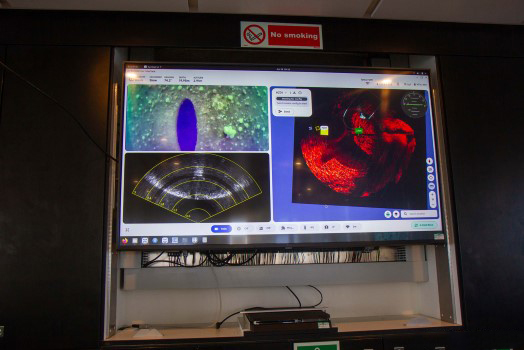
“Typically, we use an ROV, a vehicle that you operate remotely, but the KOBINE project has allowed us to use an autonomous underwater vehicle, said the biologist.
“You can pre-programme it, and it will find its own way in the water. We were trying out one of these for the first time and we had a line of communication allowing us to follow device footage on a large screen on board. Being able to observe that marine life live was a special experience.”