


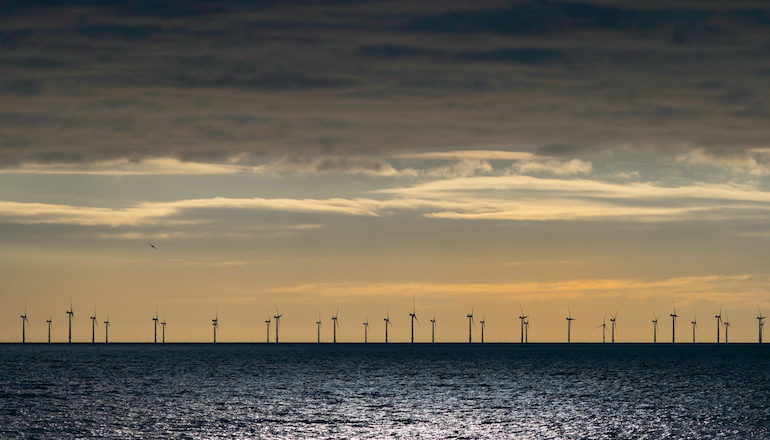
Two projects have been awarded funding by the UK Government to develop prototypes that minimise the impact of offshore wind farms on UK Air Defence surveillance.
The funding worth £3.2m has been awarded by the Defence and Security Accelerator (DASA), in partnership with the Department for Energy Security and Net Zero (DESNZ).
The first winner of the funding today is LiveLink Aerospace, a Hampshire-based aerospace company, who have been awarded up to £1.3m.
Its project will address the challenge of radar clutter caused by the rotating blades of wind turbines, which can degrade the performance of air defence radars and surveillance systems.
The firm’s work comprises of developing a series of small low-cost and robust passive air defence sensors, which do not emit any signals themselves, and therefore do not interfere with the radar returns from wind turbines.
The second winner is Trelleborg, an engineering firm based in Nottinghamshire, which has been awarded up to £1.8m in grant funding to deliver a project on the use of advanced materials in wind turbines to tackle radar interference.
Trelleborg will use its existing expertise in manufacturing and engineering of stealth materials to deliver next-generation wind blades which will cause less interference with radars.
Alongside this a new £500,000 competition has been launched which will help companies find solutions to accurately model and test the effectiveness of these technologies.
This will help ensure the UK remains on course to reach its ambition of 50GW in offshore wind by 2030, while supporting and co-existing with our air defence capabilities.
The Windfarm Mitigation for UK Air Defence: Phase 3 Programme is funded by the government’s £1bn Net Zero Innovation Portfolio (NZIP) and is undertaken in partnership with the Royal Air Force (RAF), the Defence Science and Technology Laboratory (Dstl), and DASA.
Energy security secretary Grant Shapps said: “Putin’s illegal invasion of Ukraine has shown us how important it is to power more of Britain from Britain.
“Our offshore wind capability plays a huge role in delivering our energy security, with world’s four largest offshore windfarms in UK waters.”
“But with the war raging on, we need to make sure our energy security and our national security remain fully compatible.
“This funding will ensure our offshore wind works alongside our latest air defence technologies – boosting our defences through our military, and by delivering home-grown energy for our homes and businesses.”