


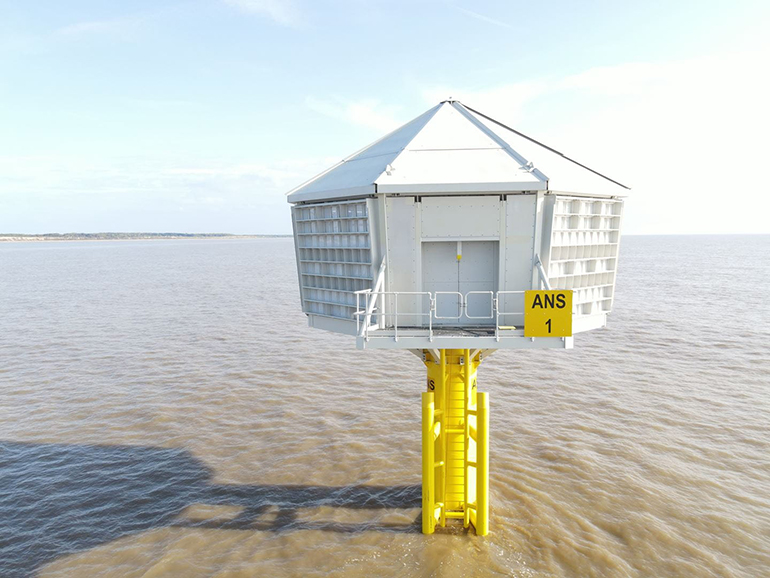
Orsted has commissioned three “industry-first” nearshore artificial nesting structures (ANS) specially designed to house kittiwake off the east Suffolk coastline of England.
The nearshore ANS have been installed as part of innovative plans to compensate for potential impacts of the Hornsea 3 wind farm on the vulnerable seabird species said the developer.
The structures are located approximately 1km offshore, with one close to the Minsmere Nature Reserve and the other two near South Beach, Lowestoft. These sites place the systems close to existing kittiwake colonies, but minimise disturbance to residents and business owners.
As the first UK offshore wind project to require ecological compensation, the Hornsea 3 team said it undertook extensive research to identify optimum locations and design features to maximise the chance that the ANS will be colonised by kittiwake.
A team of architects, engineers and ecologists were commissioned to design the structures in collaboration with local stakeholders and an Offshore Ornithology Engagement Group, which included Natural England, the Marine Management Organisation and the Royal Society for the Protection of Birds.
Each ANS comprises an octagonal topside measuring 11 metres wide by eight metres tall with capacity for around 500 breeding pairs of birds. The structures, weighing approximately 50 tonnes, are supported above the water on a single monopile. The roof pitch and overhang were specifically designed to mitigate avian predators.
The nesting faces have alternating rows of fully partitioned, open, and semi-partitioned ledges. This experimental design will provide valuable insight on the nesting preferences of kittiwake and help inform future compensation projects for the industry.
Individual nesting spaces are fitted with a sliding Perspex panel to allow researchers to view the kittiwake from inside the structures without the birds being able to see them, as well as allowing for safe handling for monitoring purposes.
Two cameras on each ANS capture the birds’ prospecting and nesting attempts. Orsted will continue to monitor the existing colonies in Lowestoft and Sizewell for the lifetime of the ANS and is also providing an initial £50,000 of funding to the Lowestoft Kittiwake Partnership, which aims to safeguard nesting birds.
Suffolk-based Red7Marine took the Principal Contractor role for the fabrication and installation of the ANS, working closely with partner Four Tees Engineering to deliver the unique octagonal structures. All components were delivered to the quayside at Lowestoft for load out onto a jack-up barge before being transported out to location and installed.
“Kittiwake are listed as at risk from extinction and with climate change as a key driver to their decline, a move towards a green energy system could help considerably in the long-term conservation of the species,” said Orsted environmental manager Eleni Antoniou.
“In the meantime, the provision of these structures will provide a safe, nesting space to enable future generations to raise young away from predators and out of town centres,” she added.
“This is a first of its kind project that required a great deal of collaborative work with stakeholders, architects, engineers and ecologists to develop a bespoke solution. We have already had our first kittiwake visitor to the structures and look forward to seeing our first long-term residents. We’d like to thank all those involved in this ground-breaking project so far.”