


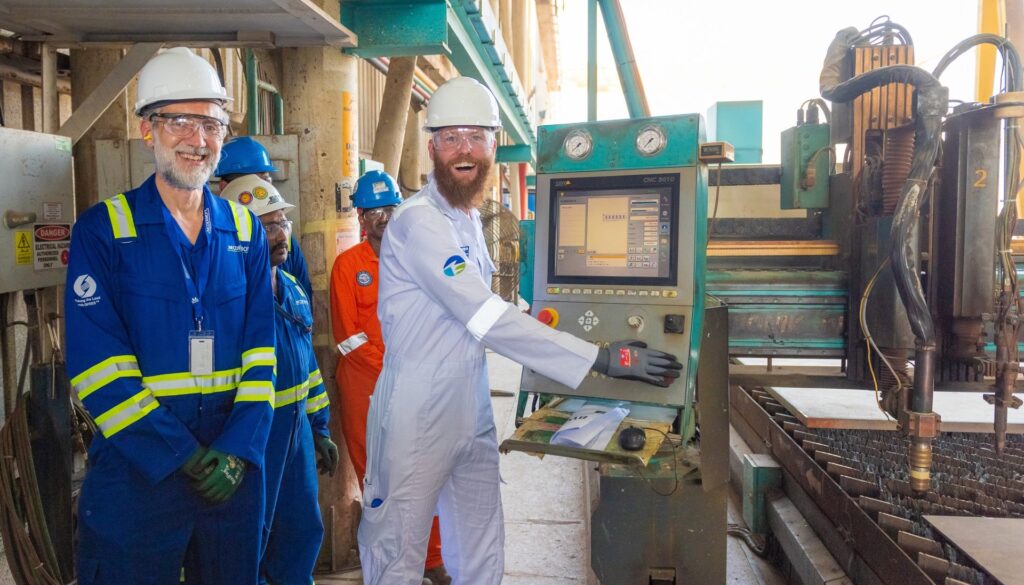
Construction on TenneT’s BorWin kappa offshore wind converter platform has begun at a shipyard in Jebel-Ali in Dubai with the first steel cut.
The BorWin kappa converter station is the starting point for the BorWin6 offshore grid connection in Germany, which will make an important contribution to the energy transition from 2027 with a grid connection capacity of 980MW.
The contract for the construction of the converter stations at sea and on land was awarded to the McDermott and GEIRI/C-EPRI consortium in February 2022.
The BorWin6 project will implement a high-voltage direct current (HVDC) transmission of 980MW from the offshore wind farm to the extra-high-voltage grid in Büttel (Schleswig-Holstein).
The wind power produced at sea off the coast of Lower Saxony is fed as three-phase current to TenneT’s BorWin kappa converter platform, where it is converted into direct current and transported over the 235-kilometre-long cable route to the Büttel converter station.
Here, the electricity is converted back into three-phase current and fed into the extra-high-voltage grid via the substation. Due to the distance and the power to be transmitted, direct current is suitable for low-loss transport.
The converter platform itself (topside) is placed on a substructure (jacket).
This jacket will be built in Batam (Indonesia) from September.
The topside will measure approximately 63 x 67 x 46 meters, and installation is scheduled for summer 2026.
The platform will be brought through the Suez Canal, the Mediterranean Sea and then through the Bay of Biscay to the location in the North Sea and set down on the jacket by “float-over”.
This means that the platform is positioned exactly above the jacket and then lowered precisely onto the structure.
The jacket is to be installed in the 38-metre-deep water a year earlier in the summer of 2025.
Before the end of 2023, corresponding horizontal boreholes will also be drilled to cross under the state protection dike near Büsum, and later the Kiel Canal.
The laying of the land cable will take place in 2024 and 2025, the laying of the submarine cable in 2025 and 2026.
Nexans Norway AS was commissioned to produce and install the DC cables at sea and on land.
In addition, the first preparatory measures for the land station in Büttel have been completed, and the actual construction of the land station will begin in 2024.