


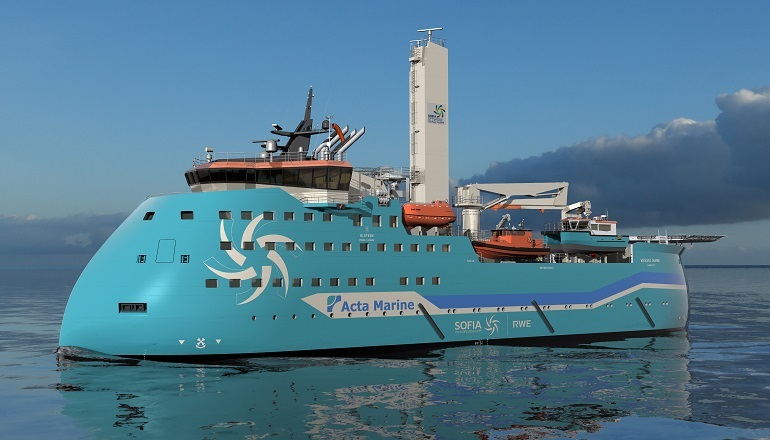
Acta Marine has entered into a long-term vessel supply agreement with RWE to build and operate two service operation vessels (SOVs) with reduced emissions.
The SOVs will be “among the first in the world” to be built with the capability of being powered by methanol and batteries, with the potential to save up to 10,000 tons of CO2 emissions every year.
Acta Marine will begin constructing the vessels at Tersan Shipyards in Turkey during the second quarter of 2023 and they are expected to begin operation in early 2025 and 2026.
Both SOVs will be methanol ready from the start and will support the day-to-day operations and maintenance of two of RWE’s largest offshore wind projects, at the newly operational 857MW Triton Knoll and the 1.4GW Sofia Offshore Wind Farm, which is now under construction.
The vessels will be based out of RWE’s new Grimsby Hub and support the long-term operations of the offshore assets.
The agreement will bring further investment into the port through the use of ship support and maintenance services, local fuelling, pilotage and other ancillary services.
The SX216 newbuild vessels, designed by Ulstein Design and Solutions, feature the Twin X-Stern improving fuel efficiency, increasing dynamic positioning capability and reducing motions and noise, making the offshore stay more comfortable, efficient and safe for technicians.
Acta managing director Rob Boer said: “We are very pleased to partner with RWE in deploying two of our new SOVs over a 12-year basis.
“The ability to use e-methanol from day one of our operations with RWE drives the reduction of greenhouse gases significantly. The vessels have been designed for high performance in-field agility and reducing power consumption as much as possible.
“While contributing to the decarbonisation of marine offshore operations, we will be proud to deliver best in class hospitality services on board our SOVs combined with leading operational performance and safe transfer of technicians to the wind farms.”
RWE is part of the Carbon Trust programme, aiming to make future offshore wind more sustainable. The body, in collaboration with RWE and other developers, is developing a new Offshore Wind Sustainability Joint Industry Programme.
This will establish guidance on how to measure and address carbon emissions associated with offshore wind farms during their lifecycle, including emissions from the manufacturing of materials and wind farms installation.