


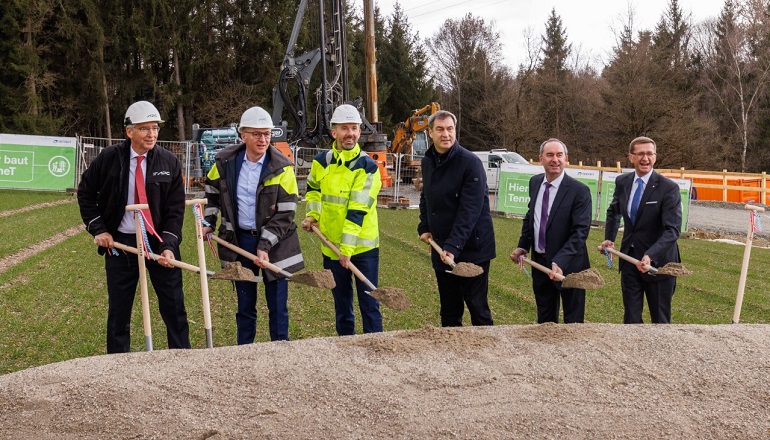
TenneT and Austrian Power Grid have kicked off a project to expand the grid between Bavaria, Germany and Austria.
The Altheim-St Peter line will begin with the construction of the first project section between the substation in Simbach am Inn and the St Peter substation in Upper Austria.
The line will connect wind power from the north and solar power from southern Germany Austrian pumped storage power plants in the Alps.
In the presence of representatives from politics, business and the media, Bavarian Prime Minister Markus Söder said: “The grid expansion in Bavaria is progressing: today, the groundbreaking ceremony for the Bavarian-Austrian power line project in Simbach in Lower Bavaria. Bavaria is fully committed to renewable energies and is investing an additional €500m here.
“At the same time, however, the power lines must also be removed. For this reason, we have once again massively increased the number of staff in the approval area. Our energy supply must become even more independent and regional.”
At the ground-breaking, TenneT Managing Director Tim Meyerjürgens added: “The realisation of this interconnector to Austria is immensely important for the power supply in Bavaria and in particular for the Bavarian chemical triangle.
“Pumped storage power plants are practically large batteries with which we can store renewable energies and retrieve them when needed.
“We are dependent on the exchange of electricity with Austria and must also provide the necessary transport capacity for this.
“This first milestone today is a great success and at the same time we must do everything we can to get the entire project and other necessary lines up and running quickly.”
Gerhard Christiner, Technical Director of the Austrian transmission system operator Austrian Power Grid, added: “This line is also the necessary connection to transport produced electricity from Germany to Austria’s alpine electricity storage facilities.
“This European flagship project is proof that the path to a clean energy future can only succeed together with a high-capacity grid infrastructure that transcends national borders.”