


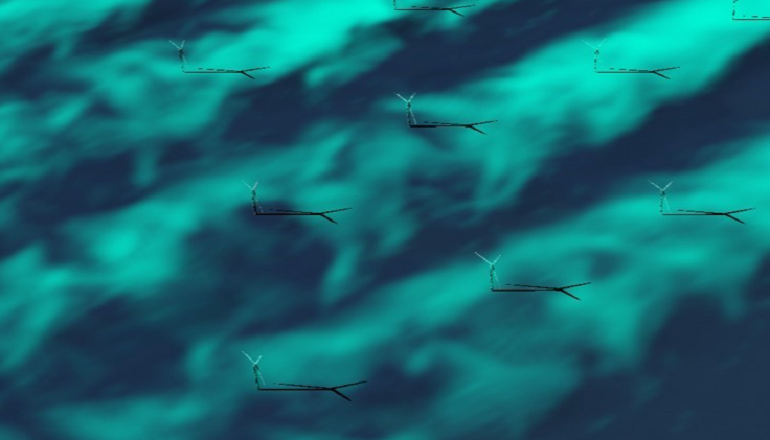
Shell is to license weather modelling software developed by Whiffle to enhance modelling capabilities for its wind and solar projects.
Erik van Iperen, General Manager Renewable Power Generation Technology, at Shell said its wind and solar portfolio will benefit from improved wind resource estimates, lower uncertainty in the annual energy yield prediction and an improved layout optimisation.
“This will help to put Shell at the forefront of wind and solar resource modelling.”
Whiffle’s technology involves running a Large Eddy Simulation (LES) model on graphics processing units (GPUs), allowing the user to perform ultra high-resolution meteorological studies at “unmatched” computational speed.
In the context of wind energy, Whiffle’s GRASP (GPU-resident Atmospheric Simulation Platform) software has proven to be particularly valuable for complex sites where the wind flow is difficult to predict, such as large wind farms that cope with significant blockage and wake effects or other locations where high turbulence is to be expected.
GRASP’s value for solar energy is also apparent, as it explicitly models cloud formations, radiation and temperature profiles.
Remco Verzijlbergh, Director of Operations at Whiffle, said: “We are very happy to collaborate with Shell in the coming years. Simulating the complex situation in clusters of wind farms in varying meteorological circumstances is a perfect application of our GRASP LES model.
“Wake losses and global blockage effects are very relevant research subjects and critical to the farm planning and operations of wind farms.
“Additionally, we look forward to cooperating with Shell in the field of solar energy modelling too, as we are convinced that GRASP will also make a difference here.”