


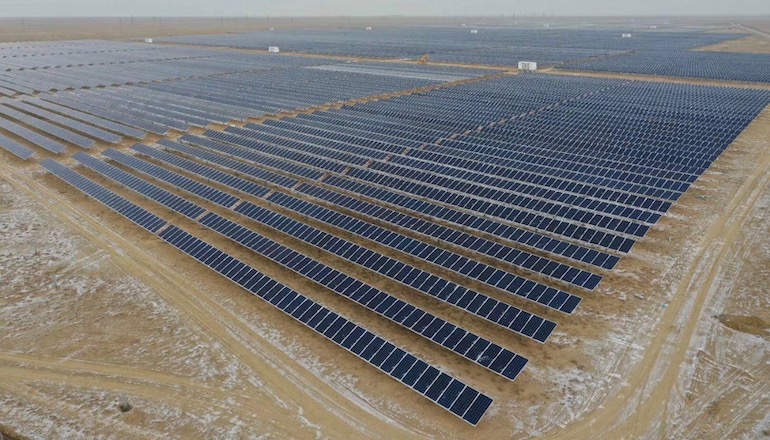
Renewables and energy efficiency offer an opportunity for a secure and sovereign energy supply in the South-East and Eastern Europe region, according to a report produced by REN21 and the United Nations Economic Commission for Europe (UNECE).
Between 2017 and 2021, 17 countries of South-East and Eastern Europe, the Caucasus, and Central Asia, plus Kosovo, saw an “unprecedented growth” in renewable power capacity.
Over this period, they cumulatively added 21GW of capacity, for a total installed renewable power capacity of 106GW.
For the first time, this growth was driven mainly by solar photovoltaic (58%) and wind power (25%) additions.
Ukraine installed the most solar PV and wind power capacity during this period (8.3GW), followed by Kazakhstan (3.7GW) and the Russian Federation (3.5GW).
Despite breakthrough progress in renewables, these focus countries continue to depend heavily on fossil fuel sources and rely on a limited number of energy exporters, especially the Russian Federation.
According to the report, Armenia, Belarus, Georgia, and Moldova import more than 70% of their total primary energy supply.
Renewables could help countries diversify their energy supply and protect against fluctuating natural gas and oil prices.
Large subsidies for fossil fuels and low tariffs for fossil and nuclear based energy hinder rapid deployment of renewables across all sectors.
Although the size of energy subsidies as a share of gross domestic product (GDP) has declined in all the focus countries, it was still significant in 2020, especially in Uzbekistan (6.6%), Turkmenistan (3.2%), Kazakhstan (2.6%) and Azerbaijan (2.4%).
“Renewable energy growth in the region through 2021 was driven mainly by favourable policies and by the falling costs of renewable energy technologies – but now, energy security is absolutely at the forefront.
“Moving away from fossil fuel has never been as vital for the region,” said Rana Adib, REN21 Executive Director.
UNECE Executive Secretary Olga Algayerova added: “With the UN climate talks (COP27) only a few months away, countries and investors in the UNECE region must urgently redouble their commitments to renewables deployment to achieve global net zero targets and end fossil fuel dependency.
“This action is also vital to help countries get on track to meet the UN Sustainable Development Goals and to speed the transition to resilient energy systems.
“Scaling up renewables investment is crucial to strengthen energy security and affordability in light of the energy and financial shocks related to the conflict in Ukraine.”
As a consequence of the Russian Federation’s invasion, around 90% of the installed wind power capacity and around 30% of the installed solar power capacity in Ukraine was out of operation as of June 2022.
This affected nearly a quarter of the region’s total wind capacity and a fifth of its solar capacity since Ukraine has been a leader in renewable installations and investment in recent years.
“The Russian invasion of Ukraine and its spill over effect on neighbouring countries is undermining renewable energy generation in the short term.
“At the same time, it has shed new light on the benefits of a rapid energy transition and could bring a surge in renewable installations in the region,” said Adib.