


Denmark and the other Baltic countries have reached an agreement to achieve a seven-fold increase in electricity generation by offshore wind built in the Baltic Sea by 2030.
The agreement, to increase installed capacity from around 3GW today to 20GW by the end of the decade, was announced at the Baltic Sea Energy Security Summit taking place today in Marienborg, Denmark.
There are also plans to consider a 2040 target at a later stage.
WindEurope CEO Giles Dickson said: “The Baltic Sea will be a key part of Europe’s build-out of offshore wind. Today’s summit brings important new commitments from the eight Baltic governments.
“It’s good they recognise the key role of cross-border collaboration. This will be essential, especially on grid development and maritime spatial planning. And it’s important the eight countries support investments in the offshore wind supply chain and in ports and other logistics infrastructure, using the significant EU recovery funds that are available.”
Germany and Denmark are currently the only Baltic countries with large-scale wind farms in the Baltic Sea, but other nations are now targeting capacity expansion.
According to WindEurope, Poland aims to have 6GW online by 2030 and 11GW by 2040, while Finland is aiming to bring its first large-scale wind farm online by 2026/27 and another one by 2028.
In Sweden, 15GW of projects are currently applying for permits, some of which could be constructed before 2030.
Estonia, Latvia and Lithuania all want to commission their first offshore wind farms before 2030.
Development of offshore wind at the scale envisioned requires significant investments in offshore grid infrastructure, port facilitates and vessels.
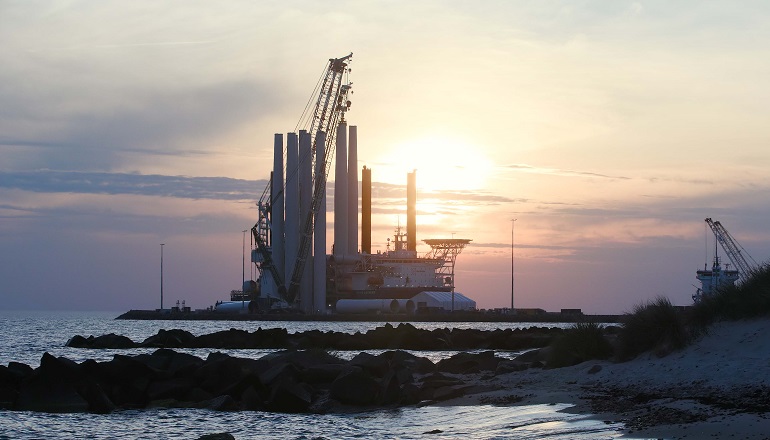
Responding to today’s announcement, Denmark’s Port of Roenne said it is now accelerating the enlargement of its harbour area to accommodate the need for more offshore wind energy in the Baltic Sea.
The port’s planned expansion will enable it to manage multiple projects at the same time within a few years.
“The Baltic Energy Security Energy Summit is a powerful manifestation of how the countries of the Baltic Sea Region intend to intensify their collaboration on the enlargement of OWE capacity to enable us to become independent of Russian gas,” said Port of Roenne CEO Lars Nordahl Lemvigh.
“This need will only grow in the years ahead, meaning that port infrastructure for OWE projects in the Baltic Sea Region can become scarce within a few years.
“Accordingly, we are accelerating our planned enlargement of harbour facilities that will enable us to manage multiple projects at the same time within a few years.”