


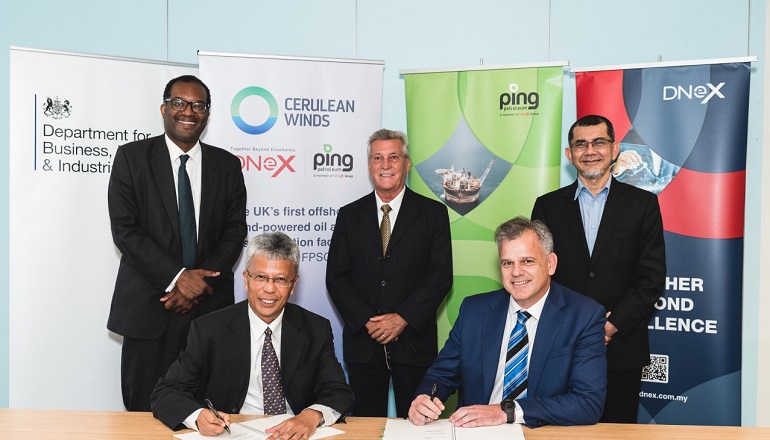
Cerulean Winds has signed an agreement with Ping Petroleum UK paving the way for establishing one of the UK’s first oil and gas facilities to be powered mainly by offshore wind.
Under the agreement signed in a meeting hosted by Secretary of State, Kwasi Kwarteng, the production facility at Ping Petroleum’s Avalon site, located in the UK Central North Sea, will be mainly powered by floating offshore wind.
The project will help meet the emissions reduction targets agreed between government and industry in the North Sea Transition Deal in March 2021.
The project will demonstrate the use of floating offshore wind in decarbonising oil and gas production.
Later this summer, applications will open to developers for seabed leases to drive the decarbonisation of other oil and gas assets across the North Sea.
Ping Petroleum UK acquired a 100% stake in the Avalon site in August 2021, with production expected to begin in 2025.
The field has a total estimated recovery of 23 million barrels of oil and the proposed development concept for the plans have already been cleared by the North Sea Transition Authority (NTSA).
Under these plans, Cerulean Winds with its industrial partners will provide a large floating offshore wind turbine which will be connected, via a cable, to Ping Petroleum’s Floating Production & Storage vessel.
This will be one of the largest floating wind turbines built in the UK and will provide the majority of power required by the production & storage vessel.
The partners are exploring options to supply excess energy to other nearby production facilities.
As part of the agreement with Ping, Cerulean Winds have committed to fully manufacturing and assembling the offshore wind turbine in the UK.
The project is expected to realise between £80-100m in investment in the development and in the UK’s renewable energy supply chain, Cerulean said.
The project was enabled by a grant to Cerulean Winds through the Floating Offshore Wind Demonstration Programme from the UK Government’s Department of Business, Energy and Industrial Strategy (BEIS) to support the innovation and optimisation of the technology that will be deployed.
Dan Jackson (pictured, seated, right), Founding Director of Cerulean Winds, said: “We are thankful to BEIS for encouraging research and development which highlights to potential investors that the UK Government endorses the rapid development of integrated floating offshore wind technologies to support industrial decarbonisation.”
Kwarteng (pictured, far left) said: “The North Sea oil and gas sector has been a major British industrial success story for decades … Platform electrification projects such as this are a welcome step forward to reduce emissions from oil and gas production, secure jobs and new skills and deliver on the commitments of the landmark North Sea Transition Deal.”
Cerulean Winds has previously announced a floating offshore wind and green energy proposal for Crown Estate Scotland’s Innovation & Targeted Oil and Gas seabed leasing round.