


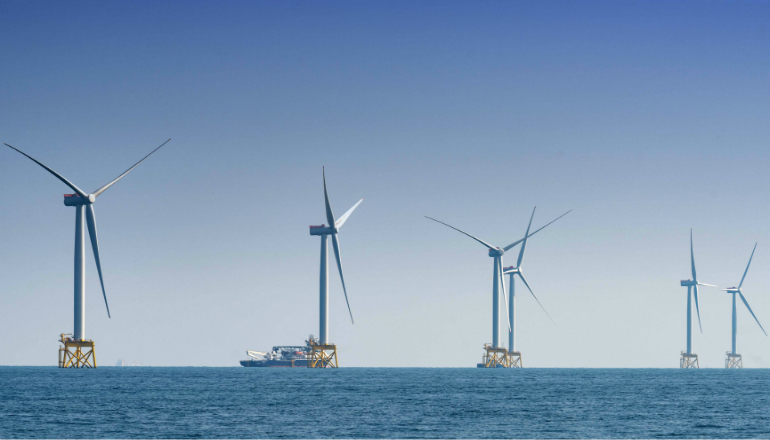
National Grid ESO has published its long-awaited report detailing how transmission links for 23GW of new-build offshore wind capacity around the UK will be coordinated in the coming years.
The Holistic Network Design – Pathway to 2030 report primarily focuses on 8GW of offshore wind projects that secured leases in the Crown Estate’s Round 4 leasing round and 11GW in Crown Estate Scotland’s ScotWind leasing round.
Assumptions on the upcoming Celtic Sea leasing round have also been made, with analysis based on three projects with a combined capacity of 1GW.
An additional 3GW of sites that are located near to Round 4 and ScotWind sites have also been included in the scope of the report.
Of the 18 wind farms in its scope, nine have been recommended for radial connections and nine for coordinated connections.
The design leads to additional £7.6bn of capital costs and represents one of the largest investment plans in UK electricity transmission networks since the 1950s and 1960s.
However, National Grid ESO states that these costs are outweighed by the £13.1bn savings in constraints costs that are expected to result from the additional network capacity.
The HND was developed as part of National Grid ESO’s role in the Offshore Transmission Network Review (OTNR), launched by the Department for Business, Energy and Industrial Strategy (BEIS) in July 2020.
BEIS has also published today a list of pathfinder projects as part of its OTNR.
These are Equinor’s proposal for shared transmission infrastructure between Sheringham Shoal and Dudgeon extensions off East Anglia, Orsted’s proposals for Gigastack, a hydrogen electrolyser at Hornsea 2 in the North Sea, and Boudicca, a 200MW onshore battery to be collocated with the grid connection at Hornsea 3, and Project Aquila, an SSEN and HVDC Centre-led scheme enabling multi-vendors to share connections into Peterhead.
In addition to these projects, BEIS said that National Grid’s Sea Link, National Grid Ventures’ EuroLink and Nautilus, and RWE’s North Falls and Five Estuaries, have today confirmed their commitment to exploring coordinated network designs off East Anglia.
Ofgem’s Chief Executive, Jonathan Brearley, said: “Britain needs to accelerate its net zero transition and diversify our energy supplies away from imported and expensive gas to protect customers from future price shocks.
“The Holistic Network Design will play a crucial role by co-ordinating the connection of our world-leading offshore wind farm projects to the grid, boosting supplies of clean, affordable and homegrown energy.
“Ofgem is committed to working with the ESO, network companies and wind farm developers on the delivery of this grid design, so customers and local communities benefit as soon as possible.”
RenewableUK’s Director of Future Electricity Systems, Barnaby Wharton, said: “There is still a lot of work to be done, and we’re looking forward to working with the ESO and industry to connect more projects faster and provide further solutions to enable cost-effective grid upgrades”.