


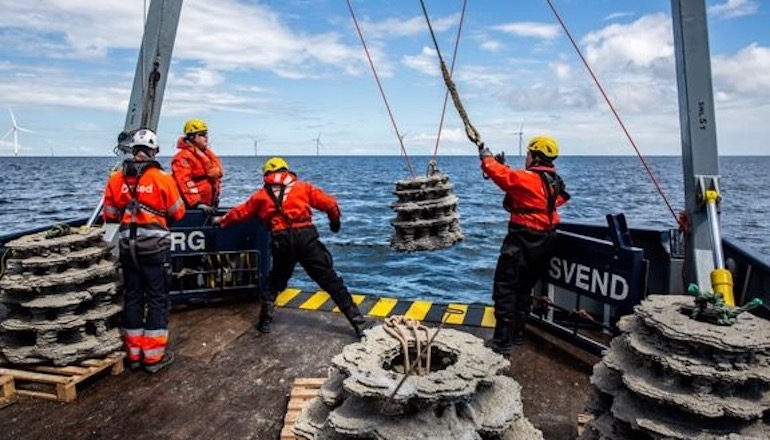
Orsted and the World Wide Fund for Nature (WWF Denmark) are testing how 3D-printed reefs can benefit biodiversity in the Kattegat, a strait between Denmark and Sweden, which is experiencing a historically low Cod stock.
This is the first time 3D-printed reefs are used in Danish waters, and they will complement existing boulder reefs that Orsted established when constructing the Anholt offshore wind farm in 2012-13.
Orsted and WWF have deployed 12 3D-printed reef structures on the seabed between the turbines at Anholt in the Kattegat, which is part of the Greater North Sea ecosystem.
Among other things, overfishing, increasing oxygen depletion, and habitat loss have resulted in a decline of the Cod stock in the Kattegat for the past 20 years.
The two partners behind the project hope that it will have positive effects on the Kattegat Cod stock and in turn contribute to a healthier, more resilient marine ecosystem with improved biodiversity.
Orsted vice president of sustainability Filip Engel said: “The ocean holds vast potential to help meet our climate goals.
“Improving ocean health and restoring marine biodiversity is fundamental to addressing biodiversity loss and the climate crisis.
“As governments around the world are ramping up ambitious plans to grow renewable energy capacity, offshore wind will take up more space.
“At Orsted, we believe action on climate and nature can and must go hand-in-hand, and this exciting project together with WWF Denmark is one of many we’re testing out globally to seek the best solutions to make our ambition of a net-positive biodiversity impact a reality.”
WWF Denmark secretary general Bo Oksnebjerg said: “Marine biodiversity in Denmark is under heavy pressure, and today there are 90% fewer Cod in the Kattegat than in 1990.
“Action is needed – and urgently. We must give nature and wildlife a hand, while trying to solve our climate crisis by expanding our renewable energy production at the same time.
“To solve the nature crisis, we must leave nature in better shape than before.
“That’s why we’re very excited that we, together with Orsted, can test the new, unique 3D-printed reef structures here in Denmark for the first time.”
The 3D-printed reefs look like a wedding cake consisting of several levels that are connected to each other by hollows where fish can swim in and out of hiding places.
At the same time, the structures themselves will provide surfaces and crevices where other organisms can attach.
The reefs are about one cubic metre big and vary in width and weight to best imitate natural habitats and weigh up to half a tonne.
Orsted has seen how the boulder reefs that the company established when constructing Anholt have become attractive oases for other marine species on an otherwise barren seabed.
The expectation is that the new 3D-printed reefs can complement the stone reefs and will quickly become inhabited with life.
WWF already has experience with 3D-printed reefs from a project in the Dutch part of the North Sea.
The project at Anholt is supported by PensionDanmark and PKA, which have 30% and 20% shares in the wind farm, respectively.
PensionDanmark chief executive Torben Moger Pedersen said: “We’re very proud to see Anholt pioneer 3D-printed reefs in Danish waters.
“Biodiversity is a focal point for PensionDanmark, and if this innovative initiative can improve biodiversity in the marine ecosystem, while the wind farm is producing sustainable power, we have a win-win situation for all concerned.”
PKA chief executive Jon Johnson said: “Protecting our planet and working towards a sustainable future is important to us.
“Biodiversity is decreasing worldwide at an alarming rate. We’re proud to support the test of artificial reefs at Anholt and its attempt to improve conditions for cod and the wider biodiversity in the area and the Kattegat.
“We’re looking forward to following the development of marine life conditions in the coming years.”