


The EU must prioritise the availability and affordability of renewables and renewable hydrogen for carbon-intensive industries such as steel, says WindEurope.
In a joint communication with the European Steel Association (EUROFER), WindEurope said decarbonising at large scale, enabled by renewable hydrogen, must become the EU’s “top priority” for reaching climate neutrality and accelerating independence from Russian fossil fuel supplies.
The partnering associations have made the call ahead of a key week where crucial decisions on energy and climate will take place at EU level.
“The worsening gas supply situation and the need to cut dependencies from Russia increase the urgency to speed up green energy infrastructure investments in the EU”, both stated.
The EU steel industry has been working on alternative production routes for more than a decade. There are now 60 low carbon projects ready to be scaled at industrial level covering the main EU steel producing countries and companies.
Today, capital investment is set at €31bn, operational costs at €54bn (pre-Russian war in Ukraine data), while clean electricity needs amount to 150TWh, half of which is for hydrogen production, by 2030.
Their CO2 emissions abatement potential is equivalent to a cut of -55% compared to 1990 levels.
Delivering on these projects hinges on an “abundant supply” of renewable electricity and renewable hydrogen.
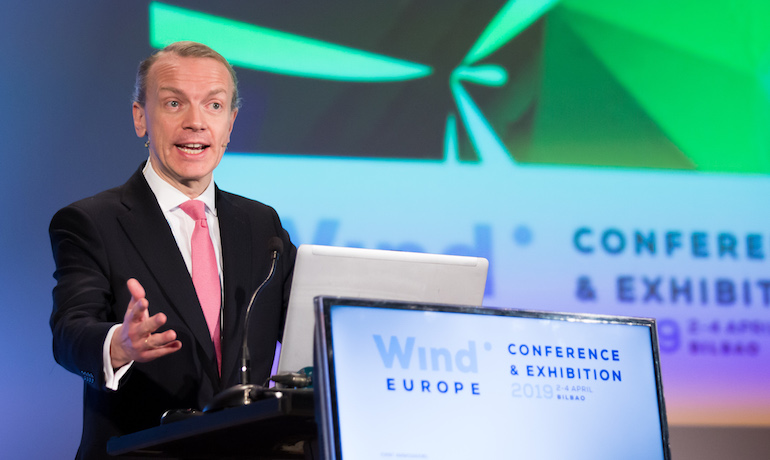
WindEurope CEO Giles Dickson said: “REPowerEU set a 510GW target for wind by 2030, that’s 39GW of new wind per year, more than double what we’re installing now.
“The wind supply chain can deliver, the finance is there.
“The bottleneck is permitting. It’s too slow and complex. Council and Parliament need to adopt the REPowerEU plan for permitting as a matter of urgency.”
Axel Eggert, director general of EUROFER, added: “Usually, industry adapts to energy supply and not vice-versa.
“There is no business case for investment in green steel if green energy carriers are not available.
“The steel industry has developed breakthrough technologies for producing low carbon steel that rely on non-fossil energy sources, but we don’t have enough renewables production nor the related infrastructure to transport it where it has the highest impact.
“The rapid expansion of wind energy and connected power grids and hydrogen production infrastructure is key for a successful transition. In return, energy producers and society can get green steel with close to zero CO2 emissions.”