


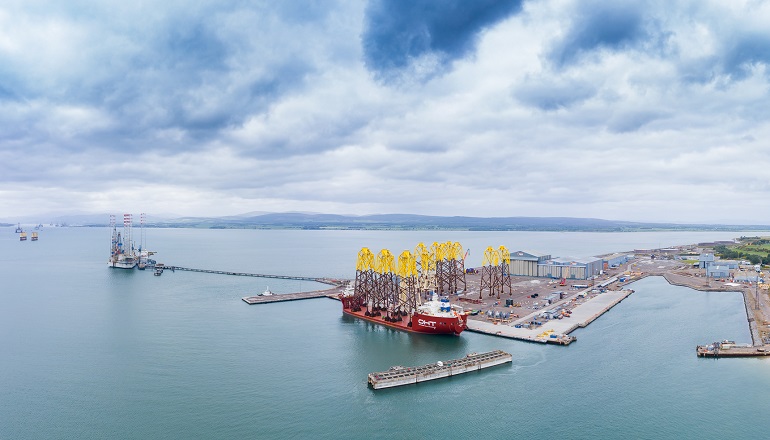
Scottish government agencies have partnered to attract international players to ports in Cromarty Firth and Moray Firth to create a floating offshore wind port cluster.
Scotland’s Highlands and Islands Enterprise (HIE) has partnered with Scottish Development International (SDI) and the Department for International Trade (DIT) with the aim of attracting overseas manufacturing companies relevant to floating wind.
The main target of this international initiative under the DIT’s High Potential Opportunities (HPO) programme is to attract inward investors from across the globe to help manufacture the main components for future floating offshore wind projects.
The focus will be on the ports of the Scottish Floating Wind Port Cluster, which were identified through the Strategic Investment Assessment report that came out in December 2021.
This independent report, commissioned by the Scottish Government and led by University of Strathclyde principal, Sir Jim McDonald, identified the ports in the Cromarty and Moray Firths – Port of Nigg, Port of Cromarty Firth, Ardersier Port and the Port of Inverness – as the nucleus of the Scottish Floating Wind Port Cluster.
Companies interested in manufacturing the huge substructures, up to 100 metres in diameter and anywhere from 3000-6000 tonnes in weight, along with the various other components required, will be invited to visit these ports and engage with HIE and the Scottish Government to explore the potential for creating a floating wind manufacturing hub in the Highlands.
The overseas manufacturing companies will also be invited to engage directly with the Scottish supply chain through the HIE-led DeepWind offshore wind cluster, and its 700 members, to ensure that Scottish companies are also benefiting directly from this enormous market opportunity.
The Scottish Floating Wind Port Cluster will also be the focus of significant job creation as the floating wind industry develops in Scotland to deliver the projects in the huge ScotWind leasing round as well as the latest round aimed at decarbonising oi and gas facilities in the North Sea – the Innovation and Targeted Oil and Gas (INTOG) round.
With 15GW of floating wind in the ScotWind round, 5GW in the INTOG round and a further potential 2GW coming from the ScotWind Clearing Round (NE1 site to the east of Shetland), Scotland will have the largest floating wind market in the world.
This 22GW of floating wind will require over 1200 floating substructures, almost five times more structures than delivered by the oil and gas Industry in the whole of the North Sea in the last four decades.