


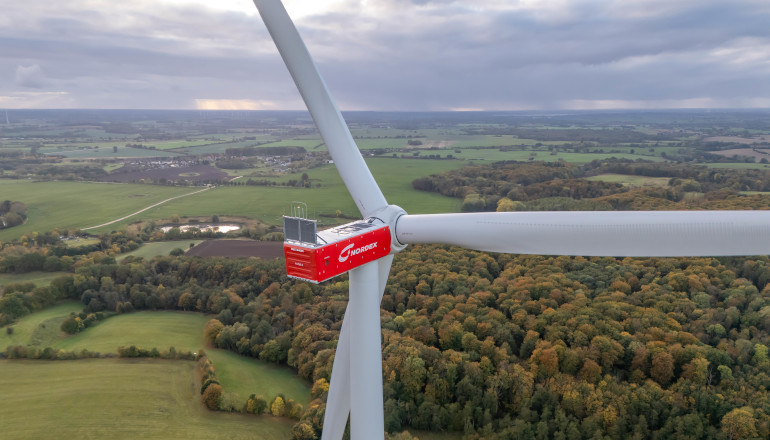
Nordex Group said in upgraded guidance that its full-year operating margin is expected to be between minus 4% and zero.
The German manufacturer’s previous guidance for the full year had been plus 1% to 3.5%.
Nordex also said that its consolidated sales will be €5.2bn to €5.7bn instead of €5.4bn to €6.0bn previously.
“The updated guidance takes into account direct as well indirect effects expected as of today of the war in Ukraine and one-off expenses for reconfiguration in the production footprint that for lack of sufficient visibility could not be included in the forecast published at the end of March,” the company said.
“In addition, the updated guidance also includes anticipated effects from supply chain disruptions coming from China and additional costs and impacts on the company’s business in connection with the cyber security incident of 31 March 2022,” it added.
Expectations for capital expenditure at around €180m and the working capital ratio of below minus 7% remain unchanged.
Nordex said the new assessment is based on the knowledge gained and impacts identified to date in the context of the preparation of the results for the first quarter of 2022.
The report for the first quarter 2022 is expected to be published on 20 June.
Nordex said that the direct impact of the war in Ukraine on Nordex Group’s business will result in the lost sales of €200m and corresponding margins in Ukraine.
Further working capital write-downs due to projects that are stopped or will not be carried out have to be anticipated, the company said.
The total direct effect of this could amount up to 1 percentage point on the EBITDA-margin in FY2022.
“Still, high volatility and ongoing disruptions in supply chain and logistics, especially in sea freight bookings, as well as substantial bottlenecks in steel and other critical components are proving to weigh heavily on projects in execution, partly as indirect consequences of the military conflict,” Nordex said.
It added that the scope and extent of these impacts are “difficult to gauge and even less so to predict”.
But, overall, the company expects these factors to have a negative impact on EBITDA-margin in FY2022 of around 2.0-2.5 percentage points.
Nordex added that its announced reconfiguration of the production footprint on the other hand is taking shape.
The planned closure of one of the Spanish production facilities for nacelles has now been completed and negotiations for the cessation of production of rotor blades in Germany are well advanced.
Nordex anticipates that one-off costs in this context will reduce the EBITDA-margin by up to 1.5 percentage points; this impact on the EBITDA-margin should be recovered in two to three years from savings in the production costs.
The company specifically encountered another two headwinds that further deteriorate originally anticipated margins this year.
One was the the lockdown in Shanghai and other municipalities in China.
This is an aggravating factor for the supply chain disruptions and mounting component availability issues, which are already affecting our European assemblies and projects worldwide.
Secondly, the cyber security incident at the end of March forced the company to shut down various IT systems in different business areas as a matter of precaution and constrained operations.
It noted that, albeit there being no indication that wind farms and third-party systems have been affected, the company’s corporate IT infrastructure has had to be recovered.
“The resulting delays and follow-up costs add to the direct costs incurred in connection with the recovery and the measures taken to strengthen the Nordex Group’s IT infrastructure,” Nordex said.
Nordex chief executive Jose Luis Blanco said: “Due to these numerous and unexpected upheavals, the year 2022 will be much more difficult than we had originally expected.
“The impact of the Ukraine war and lockdowns in China on the global economy and supply chains are affecting the wind industry and also weigh on our sales and margin development.
“We have to expect that some of these effects could accompany us into next year.
“For the medium term, we maintain that the global momentum for renewables with ever more ambitious goals to counter climate change will accelerate and also lead to a significant expansion of onshore wind.”