


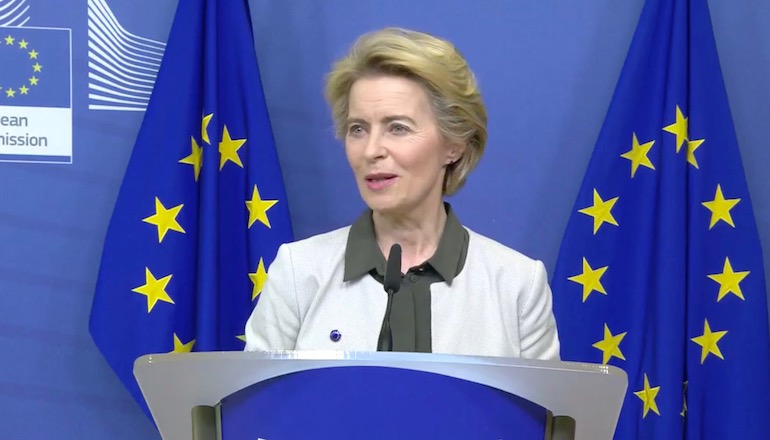
The European Commission has outlined plans to increase 2030 renewable energy targets to boost energy security and eliminate reliance on Russian fossil fuels.
Its resident Ursula von der Leyen (pictured) has proposed an increase in the headline 2030 target for renewables from 40% to 45% as part of the REPowerEU package, the Commission’s response to the global energy market disruption caused by Russia’s invasion of Ukraine.
The package includes a series of short- and long-term measures to eliminate the need for Russian fuel imports by 2027, and focus on boosting energy savings, diversifying fuel supplies and accelerating the roll-out of clean energy, von der Leyen said in a press conference today.
Ursula von der Leyen said: “Putin’s war is disrupting the global energy market.
“It shows how dependent we are on imported fossil fuels, and how vulnerable we are to relying on Russia for importing our fossil fuels.
“We must now reduce as rapidly as possible our reliance on Russia in energy.”
The REPowerEU plans include an increase in the binding energy efficiency targets from 9% to 13%, and measures to diversify gas supplies through joint purchasing initiatives and energy diplomacy.
A dedicated EU Solar Strategy aims to install 600GW by 2030, while new mandates will be introduced for the installation of rooftop PV capacity on public, commercial and residential buildings, von der Leyen added.
The initiative will also address “the elephant in the room” of permitting, European Commissioner for Energy Kadri Simson said, with a wide-ranging series of recommendations to cut lengthy and complex permitting procedures for renewables.
These measures will include an amendment to the renewable energy directive to recognise renewable energy as an overriding public interest, and establishing dedicated ‘go-to’ areas for renewable energy development.
Simson said: “Most of the Russian fossil fuel imports into the EU can be replaced by energy savings and renewables.”
By 2030, the share of wind and solar energy in the EU’s installed capacity would double from 33% to 67%, Simson added.
He said: “And by then solar energy would also be the largest electricity source in the EU… and wind energy would represent 31% of installed capacity.
“This is a challenging objective but it is feasible considering our strong renewables industry and continuous technical progress.”
In all, the Commission will mobilise €300bn of investment in the plan, with 95% of financing earmarked for speeding up the energy transition.