


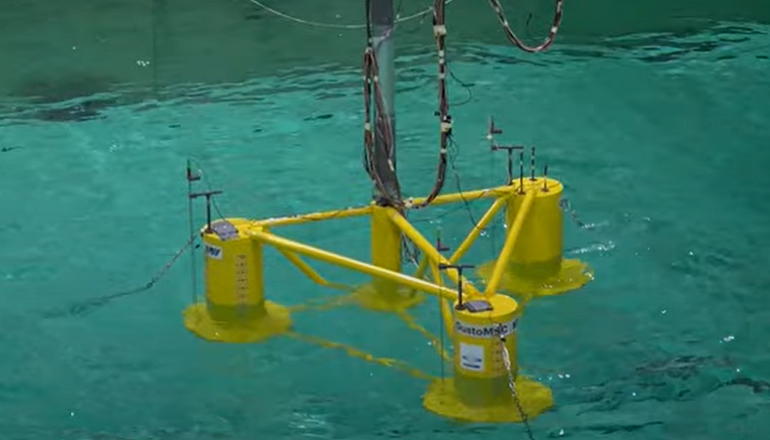
GustoMSC has recently completed model tests on its proprietary semi-submersible floater capable of hosting very large wind turbines.
The tests were performed at the Oceanide wave basin in south-east France on a 1:50 scale model of the Tri-Floater hosting the 15MW NREL reference wind turbine.
The floater was subjected to simultaneous wind, wave and current loading in the wave basin.
Due to the optimised geometry of the submerged structure, the Tri-Floater design exhibited low accelerations at the wind turbine nacelle during the model tests, in line with numerical predictions.
Lower accelerations are particularly beneficial since these translate to lower load levels and ultimately lower steel weight of the structure which is one of the most important cost drivers in floating wind.
The Tri-Floater model was subjected to a wide range of environmental conditions to demonstrate the suitability of the design for most of the floating wind sites being considered.
These included operational conditions which the wind turbine would normally see during its lifetime as well as extreme conditions which it would have to endure during storms.
An extreme sea state with a significant wave height of 13.5 metres and wind speed at hub height of 190 km/hour was tested.
The Tri-floater successfully “passed” this test and the results confirm the performance of the Tri-floater in harsh environments, said GustoMSC.