


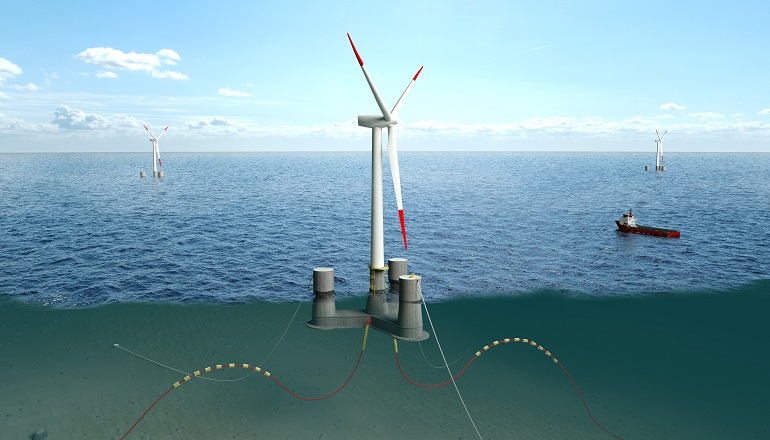
Falck Renewables and BlueFloat Energy joint venture Nora Ventu has launched a public consultation in relation to two floating wind projects off the Italian island of Sardinia.
The consultation is intended to provide local communities with more information on the Energia 1 and Nora Energia 2, which together total 1.4GW.
Nora Ventu has begun the consultation with a series of meetings with local stakeholders to outline its proposals for the two floating wind farms.
The Nora Energia 1 project proposal foresees 53 wind turbines, with a total installed capacity of 795MW, located in the sea area of the Sardinian Channel south-west of the Gulf of Cagliari, positioned at distances between 22 km (minimum distance from the coast) and 34 km from the coast.
The Nora Energia 2 project proposal foresees 40 wind turbines, with a total installed capacity of 600MW, in the stretch of the sea inside the Sardinian Channel and south-east of the Gulf of Cagliari, located about 30 km south of Capo Carbonara.
Local engagement precedes the start of the authorisation procedure, the first step of which will be a preliminary consultation process known as scoping, aimed at defining the scope of the environmental impact study.
Requests for a maritime concession for each of the two projects were filed with the Ministry of Infrastructure and Sustainable Mobility and the Port System Authority of Cagliari at the end of December 2021.
Nora Ventu estimates 4000 direct jobs will be created in the manufacturing, assembly and construction phases of the floating wind farms.
Once operational, the projects are expected to generate more than 300 long-term jobs will be created for maintenance activities, of which around 80% of the workforce will come from the local area.
Goods and services for the construction and maintenance of the floating offshore wind farm will be primarily sourced from local companies and training schemes will be hosted in preparation.
Local infrastructure is also set to benefit as the projects would rely on the main industrial ports, such as the Port of Cagliari, for the assembly, operations and maintenance of the wind farms, allowing diversification of their infrastructure and services.
As the wind farm projects develop there will be opportunities for study and research and the potential to work in partnership with Sardinian universities, research centres and technology parks on cutting-edge projects.
Visual impact analyses already carried out and due to be submitted in the coming weeks, show that the proposed offshore wind farms, which would be located outside the territorial waters, would be almost imperceptible to the human eye from the coast.