


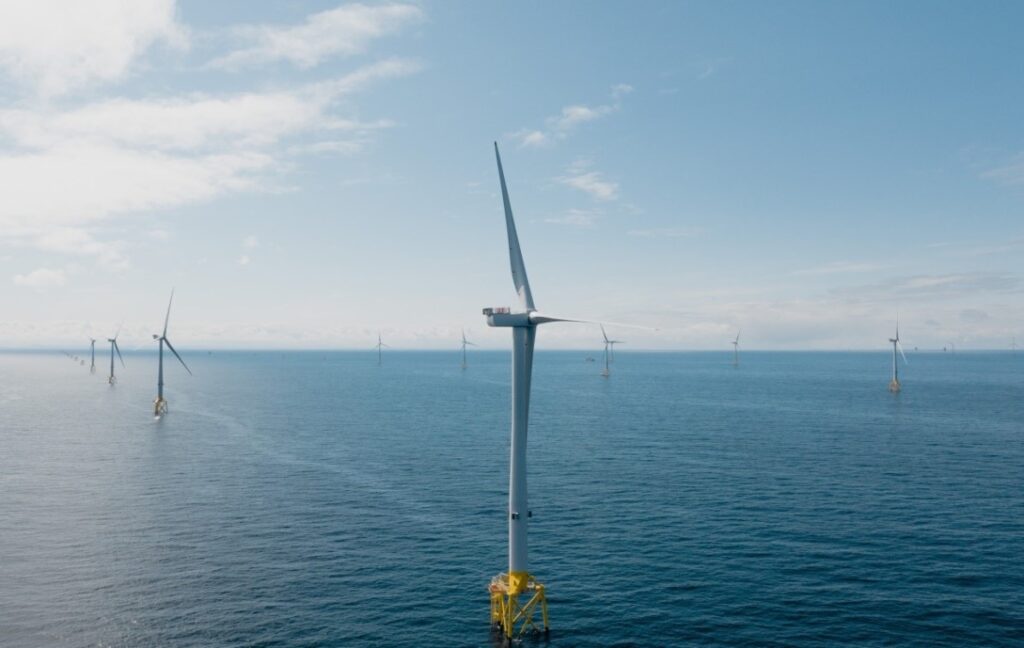
EDP Renewables (EDPR) and Engie JV Ocean Winds has announced the installation of the last of its 100 turbines at Scotland’s 950MW Moray East offshore wind project.
Ocean Winds has been developing offshore wind in the Moray Firth since EDPR won the rights to develop offshore wind there in the UK’s 3rd round of offshore wind leasing in 2009.
The windfarm began generating when its first few turbines came online in June and has been gradually increasing output as more turbines are firstly installed then commissioned.
The commissioning work is expected to be completed before the end of the year.
The Moray East project has the capacity of producing the power for average requirements of 950, 000 UK homes, and sufficient electricity to save 1.4 million tonnes CO2 equivalent annually (assuming displacement of gas generation).
Power will be generated at £57.50/MWhr, the lowest cost of any new renewable generation in operation.
Ocean Winds chief executive Spyros Martinis said: “We are very proud of this last achievement that positions Moray East as a succesful and innovative project in the offshore wind sector.
“Moray East is among our most important projects and this new milestone is one of the last steps towards the full operation expected by 2022.
“Our mission is to deliver more efficient and sustainable wind energy solutions to the local communities through our deep industry knowledge and expertise.
“In this sense, our commitment to Scotland and its economy is reflected in our efforts to develop these projects.”
Moray East project director Enrique Álvarez said: “In the face of unprecedented global conditions we have safely completed the installation of 100 turbines within the challenging timescale of a single season, and I would like to thank and congratulate all those involved in achieving this milestone safely.
“Just a decade ago, commercial-scale offshore wind generation in water depths of 50m and more was a vision.
“We have not only turned that into a reality, but are generating power at less than half the cost of earlier windfarms in shallow water, close to shore.
“Now we turn to the task of commissioning the turbines and bringing the windfarm up to its full generating capacity – ultimately enough to meet 40% of Scotland’s domestic electricity needs.”