


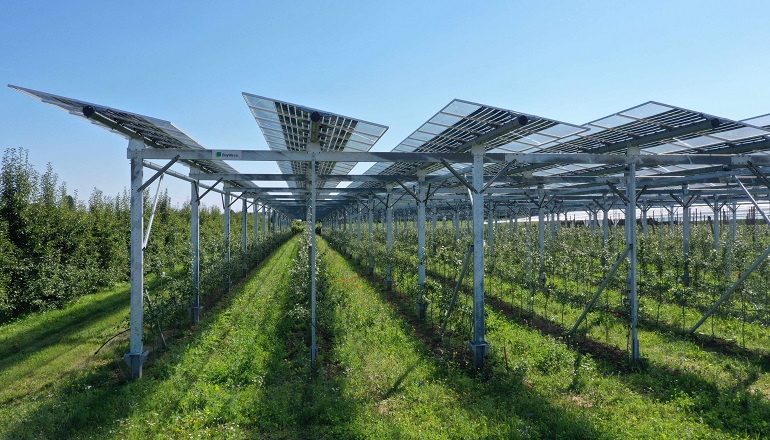
BayWa and the Fraunhofer Institute for Solar Energy Systems ISE, together with other research partners, have built the first agri-PV research facility for apples and espalier fruit in Germany.
The new facility is located at the Nachtwey organic fruit farm in Gelsdorf in Rhineland-Palatinate.
The primary objective of the project, which is funded by the German Ministry of Environment, Energy, Food and Forestry of Rhineland-Palatinate (MUEEF) and the Federal Ministry of Food and Agriculture (BMEL), is to increase climate resilience in fruit growing and to ensure safe and sustainable apple production with additional solar power generation.
As part of the project, which will run for five years, numerous factors will be investigated on eight varieties of apple.
The project will begin by comparing apple production at the same site under three different crop protection systems. These are: foil protection (non-rain permeable), hail protection (rain permeable), and agri-PV with fixed light permeable PV modules (non-rain permeable) and tracked PV modules (rain permeable when needed).
The project will investigate to what extent agri-PV systems can protect plants and fruit from harmful environmental influences such as hail, heavy rain, sunburn, frost or extreme temperatures.
It will also explore light management options by testing different PV module configurations to identify the impact on plant growth and agricultural yields.
Finally, the project will take into account the landscape aesthetics, economic efficiency, social compatibility as well as crop production parameters.
Stephan Schindele, head of product management agri-PV at BayWa r.e., said: “We see agri-PV as a long-term solution to help farmers adapt to the consequences of climate change.
“We can preserve the existing ecosystem and even enhance it through synergy effects and solar power generation.”
In addition to adapting to climate change and protecting agricultural assets, the project in Gelsdorf also aims to demonstrate the economic benefits for farmers.
These include permanently lower and more predictable energy costs, lower investment costs in crop protection, and lower operational and waste disposal costs.